Dynasties
Five Dynasties and Ten Kingdoms: States, Timeline, and End
The Five Dynasties and Ten Kingdoms were a period of competing states after the fall of the Tang Dynasty. The Five Dynasties ruled one after another from the Central Plain in northern China. The Ten Kingdoms were other regional states, mostly in the south, with Northern Han based in the north.
The Five Dynasties are usually dated from 907 to 960, when the Song replaced the Later Zhou. Several kingdoms survived the founding of the Song; Northern Han fell only in 979. Both end dates are useful, depending on whether the question concerns the five northern dynasties or the last of the traditionally listed ten kingdoms.
Key Facts
- Five Dynasties
- Later Liang, Later Tang, Later Jin, Later Han, Later Zhou
- Five Dynasties period
- 907–960
- Last of the Ten Kingdoms
- Northern Han, conquered in 979
- Geography
- The Five Dynasties centered on the Central Plain; most of the Ten Kingdoms were in the south
- Historical setting
- From the fall of Tang to the Song's gradual expansion
Why Did China Divide After the Tang?
By the late Tang, regional military governors, known as jiedushi, controlled troops and resources in many areas. The Huang Chao rebellion and subsequent wars altered the balance of power further. Some commanders continued to acknowledge the Tang court while competing for territory and influence.
One of them, Zhu Wen, had served the rebel Huang Chao before surrendering to the Tang. He eventually gained control of the court. In 907 he compelled the last Tang emperor to abdicate and founded the Later Liang. The dynasty changed in that year, but regional rivalry had begun earlier and continued afterward. For the broader background, see why the Tang Dynasty fell.
The Five Dynasties in Order
| Order | Dynasty | Years | Founder | Principal capitals |
|---|---|---|---|---|
| 1 | Later Liang | 907–923 | Zhu Wen | Kaifeng and Luoyang |
| 2 | Later Tang | 923–936 | Li Cunxu | Luoyang |
| 3 | Later Jin | 936–947 | Shi Jingtang | Luoyang and Kaifeng |
| 4 | Later Han | 947–951 | Liu Zhiyuan | Kaifeng |
| 5 | Later Zhou | 951–960 | Guo Wei | Kaifeng |
Each dynasty was centered on the Central Plain; none should automatically be imagined as ruling all of present-day China. Some dates differ by a year in historical tables when a transition crossed the end of a calendar year.
The Later Liang faced a strong rival in the northwestern region of Hedong, ruled first by Li Keyong and then by his son Li Cunxu. In 923 Li Cunxu founded the Later Tang and captured Kaifeng, ending the Later Liang. The Later Tang expanded, but court conflict and military revolts weakened it.
Shi Jingtang established the Later Jin in 936 with military help from the Khitans, whose Liao state lay to the north. In return, the Later Jin ceded the Sixteen Prefectures, a frontier region around parts of present-day Beijing and northern Hebei and Shanxi. The loss changed the strategic relationship between the Central Plain and the Liao.
Relations between Later Jin and Liao later deteriorated. A Khitan invasion ended the Later Jin around the turn of 946–947. Liu Zhiyuan proclaimed the Later Han at Taiyuan in 947; after the Khitan forces withdrew from the Central Plain, his regime entered Kaifeng. The Later Han itself fell after conflict between its court and military leaders, and Guo Wei founded the Later Zhou in 951.
Timeline: From Tang to Song
Timeline
907
The Tang ends and Zhu Wen founds the Later Liang
923
Li Cunxu founds the Later Tang and defeats the Later Liang
936–947
The Later Jin rises with Khitan support and later falls
947–951
The Later Han and then the Later Zhou are founded
954–959
Later Zhou ruler Chai Rong reforms and campaigns
960
Zhao Kuangyin founds the Song after the Chenqiao Mutiny
971–978
Southern Han and Southern Tang fall; Wuyue submits
979
The Song conquers Northern Han
What Were the Ten Kingdoms?
The conventional list is Wu, Southern Tang, Wuyue, Min, Chu, Southern Han, Former Shu, Later Shu, Jingnan (also called Nanping), and Northern Han. They did not all exist at once. Southern Tang replaced Wu, for example, and Former Shu and Later Shu governed Sichuan at different times.
| Region | Kingdoms | Main centers |
|---|---|---|
| Lower Yangtze and southeast | Wu, Southern Tang, Wuyue | Yangzhou, Jinling and Hangzhou |
| Fujian and Hunan | Min, Chu | Fuzhou and Changsha |
| Lingnan in the far south | Southern Han | Guangzhou |
| Sichuan Basin | Former Shu, Later Shu | Chengdu |
| Middle Yangtze | Jingnan | Jiangling |
| Northern China | Northern Han | Taiyuan |
These centers help locate the states; they are not precise borders. The Khitan Liao state was a major neighbor of the Five Dynasties and Northern Han, but it is not one of the conventional Ten Kingdoms. Other regional powers also existed beyond the familiar list.
How Did the Regional Kingdoms Survive?
Their rulers needed food, revenue and soldiers while navigating threats from neighbors. Wuyue governed from Hangzhou and maintained relationships with the courts of the Central Plain as well as investing in local administration and waterworks. Its rulers fought wars too; in 978 its last king, Qian Chu, submitted his territory to the Song.
Southern Tang expanded from the lower Yangtze into neighboring regions but lost territory north of the Yangtze to the Later Zhou. The Song defeated it in 975. Former Shu and Later Shu each controlled a base in the Sichuan Basin; mountains offered protection, but neither regime lasted indefinitely.
The contrast between a turbulent north and a more stable south is useful as a starting point, not a description of every place and year. Southern territories also experienced war, taxation and succession struggles, while some areas enjoyed periods in which agriculture, trade and court culture could continue.
Economy, Art, and Religion
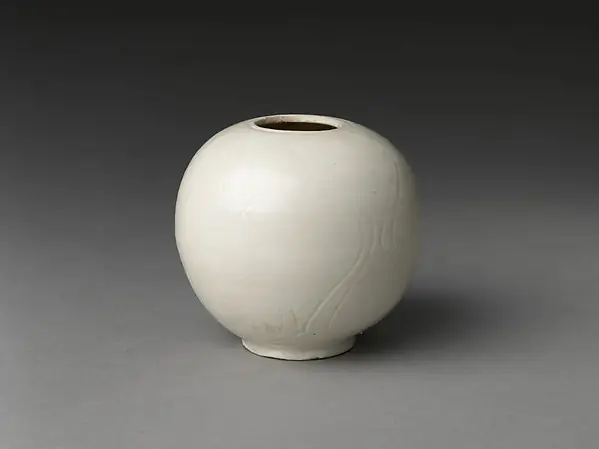
The inscription on this small jar reads “new official ware.” The Metropolitan Museum of Art identifies it as a vessel probably made for one of the competing northern courts. Similar wares were also traded beyond China; the inscription does not identify a particular ruler. The Met, object 19.56.2, public domain; resized and converted to WebP.
War did not stop all farming, production or exchange. Courts needed resources to support soldiers and administrators, and goods such as ceramics continued to circulate. A fine surviving object, however, cannot by itself show how prosperous ordinary households were throughout the period.
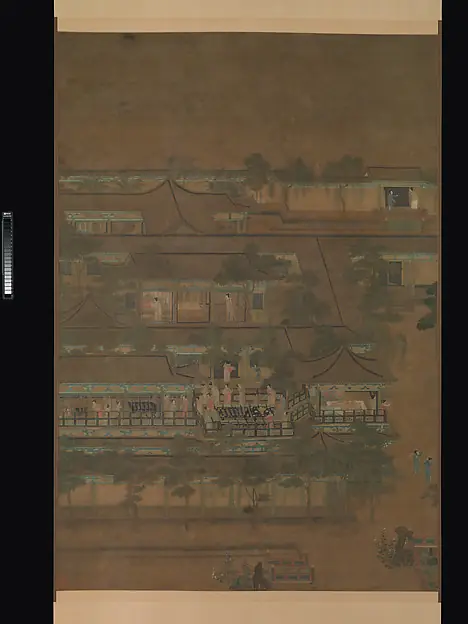
The museum dates this painting to the Five Dynasties or Northern Song. It depicts a Tang court subject, not a documented scene at a Five Dynasties banquet. The Met, object 2010.473, public domain; resized and converted to WebP.
Poetry and painting continued at regional courts. The poems of Li Yu, the last ruler of Southern Tang, survived the fall of his state, although individual works and later interpretations should not be treated as a complete portrait of society. Buddhist communities and patrons also continued their religious activities.
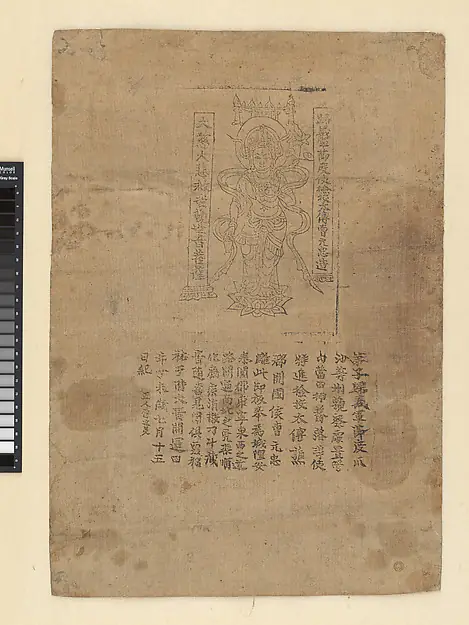
This print from the Dunhuang area is dated 947. The Met connects it with Buddhist patronage for travelers. Its small inscription is difficult to read on a phone and is not needed to follow the text here. The Met, object CP5, public domain; resized and converted to WebP.
How Did the Period End?
Chai Rong, ruler of the Later Zhou, reorganized military and financial resources and campaigned against neighboring states. After his death, a child succeeded him. In 960 the military commander Zhao Kuangyin took the throne following the Chenqiao Mutiny and founded the Song Dynasty. That ended the sequence of five dynasties, not the independence of every regional state.
The Song expanded over the following years. Southern Han fell in 971 and Southern Tang in 975; Wuyue submitted in 978. In 979 Song forces captured Taiyuan and ended Northern Han. Even then, the Song continued to share frontiers with the Liao and other powers; its territory did not simply reproduce the full extent of the Tang empire.
For the longer sequence before and after this period, see the Chinese dynasties timeline.
Frequently Asked Questions
Was this one dynasty?
No. The name groups several successive and overlapping states into a historical period. The Five Dynasties ruled in succession, while the Ten Kingdoms were a conventional list of regional regimes.
Did the period end in 960 or 979?
The Later Zhou ended and the Song began in 960, closing the sequence of Five Dynasties. Northern Han, the last state in the conventional Ten Kingdoms list, fell in 979. The dates refer to different boundaries.
Were all ten kingdoms in southern China?
No. Most were in the south or southwest, but Northern Han was based at Taiyuan in the north. The kingdoms also began and ended at different times.
Was the Liao one of the Ten Kingdoms?
No. The Khitan Liao was a powerful neighboring state outside the traditional list. Its relations with the Later Jin, Later Zhou, Northern Han and Song are nevertheless essential to the history of the period.
Sources
- Benjamin Brose, “Credulous Kings and Immoral Monks: Critiques of Buddhists during the Five Dynasties and Ten Kingdoms,” pp. 72–73, for the period and the conventional list of regimes; the table uses different dating conventions for some states.
- Journal of Chinese History: the Song–Liao frontier, for the Sixteen Prefectures and their strategic context.
- The Cambridge History of China: the southern kingdoms, 907–979, for the regional kingdoms and the limits of the conventional label.
- Peter Lorge, The Reunification of China, contents and campaign chronology, for the Song campaigns against Southern Han and Northern Han.
- The Metropolitan Museum of Art, China, 500–1000, for the transition from Tang to Song and cultural context.