Questions
Why Did the Tang Dynasty Fall? Causes and Key Events
The Tang Dynasty fell in 907 when the military leader Zhu Wen forced the last emperor to abdicate. His takeover followed a long struggle over military power and resources, made far more destructive by the Huang Chao rebellion. No single battle or emperor explains the collapse.
Four connected developments help explain it:
- The An Lushan rebellion changed the balance between the court and regional commanders.
- Military spending and uneven control of revenue constrained the government.
- The Huang Chao rebellion devastated the capitals and disrupted the court.
- Rival commanders used their armies to control the weakened throne.
A turning point, not an immediate collapse
In 755 An Lushan, a powerful frontier commander, rebelled against the Tang dynasty. His forces took Luoyang and then Chang'an, the capital. The court eventually defeated the rebellion in 763 with help from loyalist commanders and Uyghur allies.
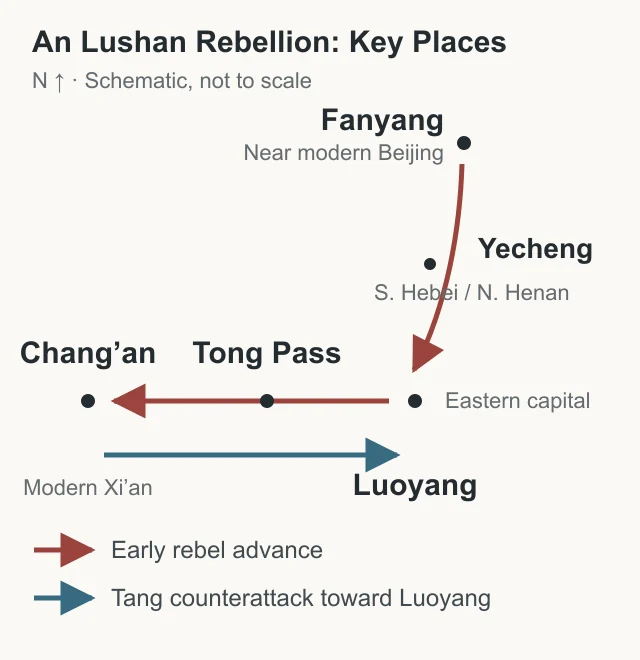
The arrows show broad directions, not exact routes or territory controlled. The war was a major turning point, but the Tang survived it by nearly 150 years. Later rulers recovered authority in some areas and the government continued to collect revenue, administer territory and support a flourishing culture. Collapse was not inevitable in 763.
Why the Tang court lost control
1. Regional armies gained lasting power
During and after the rebellion the court relied on regional military governors, known as jiedushi, to raise troops and secure territory. Some former rebels retained commands after submitting; other commands originated with loyalists. Governors did not all behave alike, but some could resist court appointments or pass authority within a local military network.
This made it harder for the emperor to move troops and resources at will. A court that depended on regional commanders for defense could not always compel those same commanders to obey. David Graff's study of Tang military organization describes how provincial commands multiplied during the war.
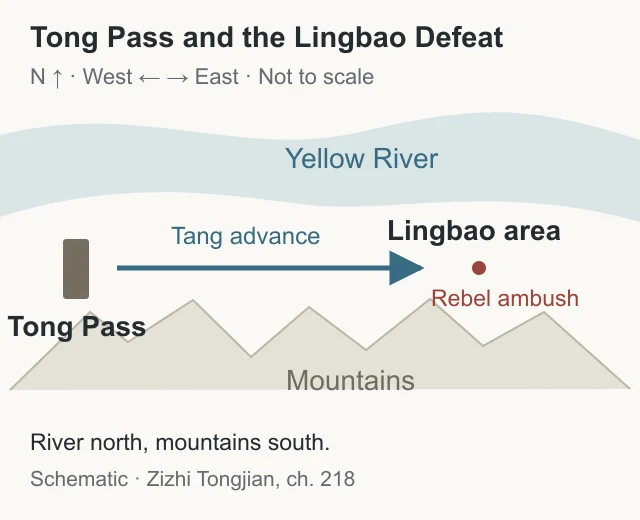
This schematic shows the terrain near Tong Pass, where Tang forces were defeated in 756; it does not reconstruct every position or the ancient river course.
2. War and taxation strained the state and households
Armies, frontier defense and campaigns against defiant governors cost money. The court could not draw equally on every region's resources. It adjusted its finances, including a tax reform in 780, but still faced the expense of maintaining its forces and bureaucracy.
The court also depended on grain shipped from the lower Yangzi through the canal network to supply the capital and armies. Disruptions to transport could make those supplies harder to move.
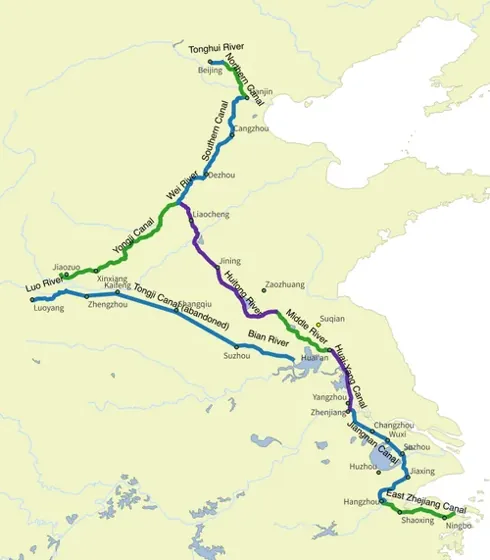
This canal map by Groverlynn, CC BY-SA 4.0, was resized and converted to WebP. It includes routes from later periods, so it is not an exact map of the Tang network.
Tax demands and conflict weighed on households as well. The Cambridge History of China account of the late Tang traces fiscal pressure, growing disorder and garrison revolts before the great rebellion of the 870s. These pressures varied over time and place; they do not mean every person joined a revolt for the same reason.
3. Huang Chao's rebellion shattered the late Tang court
In the 870s rebellions spread amid hardship and disorder. Huang Chao emerged as a major leader, and his forces moved across much of China. Around the turn of 880–881 they entered Chang'an, forcing Emperor Xizong to flee. The court recovered the capital, and the rebellion was defeated by 884, but the fighting had inflicted enormous damage and displaced the government.
4. Military rivals took over court politics
Suppressing Huang Chao strengthened commanders whose armies the court needed. Zhu Wen, a former rebel who had submitted to the Tang, built a power base around the lower Yellow River. He fought other military leaders and gained control over the emperor and the court.
Court conflicts, including struggles involving palace eunuchs and officials, made coordinated rule harder. Yet the last emperor was not the sole cause of the dynasty's end: the decisive issue in 907 was that Zhu had the military power to remove him.
Key events leading to the fall
- 755–763: An Lushan's rebellion is defeated, but regional military commands emerge with greater influence.
- 780: The court introduces the twice-yearly tax system as it adapts its finances to changed conditions.
- 874–884: Major rebellions culminate in Huang Chao's occupation of Chang'an around the turn of 880–881 and eventual defeat.
- 907: Zhu Wen forces Emperor Ai to abdicate and establishes the Later Liang dynasty.
What happened after 907?
Later Liang ruled in northern China, but Zhu did not reunify the whole former Tang empire. Other regional regimes remained in control elsewhere. The following era is known as the Five Dynasties and Ten Kingdoms: several successive dynasties ruled parts of the north while other states held territory in the south and beyond.
The difference between a long-term cause and the final act matters. Regional military power and fiscal pressures had developed over generations; the Huang Chao war destabilized the court on a new scale; Zhu's forced abdication formally ended Tang rule. For a wider view of the dynasty before these crises, see Tang trade and its routes.
How certain is this explanation?
Later dynastic histories often judged rulers and officials in moral terms. Those accounts are indispensable evidence, but their judgments and reported motives need to be read in the context of their authors and the later dynasties they served. Modern historians also differ in emphasis: some stress long fiscal and military pressures, while others emphasize how the late ninth-century rebellion disrupted a state that had adapted after 763. The Metropolitan Museum of Art's Tang overview likewise notes the long period of recovery after An Lushan.
FAQ
Did the An Lushan rebellion end the Tang dynasty?
No. It ended in 763, and the Tang continued until 907, though the balance of military power changed.
Who ended the Tang dynasty?
Zhu Wen forced Emperor Ai to abdicate in 907 and founded the Later Liang dynasty.
Did Huang Chao found the dynasty that replaced the Tang?
No. Huang Chao's rebellion was defeated in 884; Zhu Wen founded Later Liang in 907.