People
Li Zhi: Tang Gaozong, Wu Zetian, and Tang Expansion
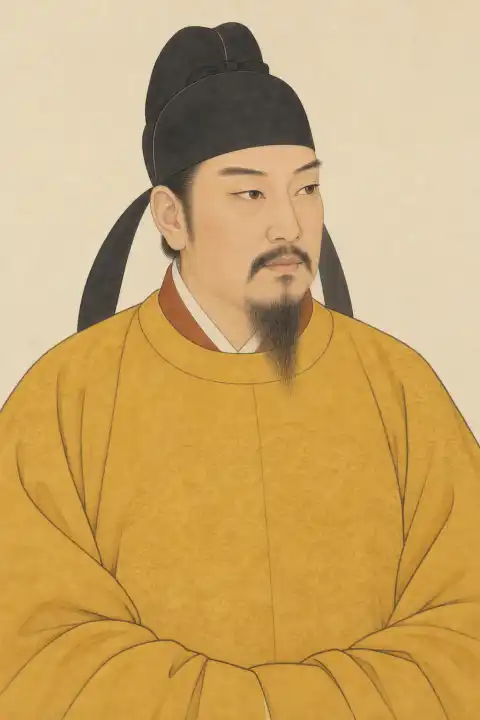
Li Zhi (李治), better known by his temple name Emperor Gaozong of Tang, was the third Tang emperor. His reign lasted from 649 to 683 and saw major victories in Central Asia and Korea, the continued development of Tang law, and the rise of his empress, Wu Zetian. He is often reduced to Wu Zetian's husband, but that leaves out much of what changed during his long reign.
Key Facts
- Identity
- third emperor of the Tang Dynasty, known as Emperor Gaozong
- Chinese Name
- 李治
- Pronunciation
- Lǐ Zhì
- Ethnicity
- Han Chinese
- Lived
- 628-683 CE
- Dynasty
- Tang Dynasty; ruled 649-683
- Known For
- Tang expansion in Central Asia and the fall of Goguryeo; sharing late rule with Wu Zetian
- Historical Role
- He carried the early Tang from Taizong's reign into a larger but harder-to-govern empire.
Quick Answer
Li Zhi became emperor after a bitter succession struggle among the sons of Tang Taizong. He inherited a powerful court, but he also had to manage senior ministers who had served his father and an empire with demanding frontier commitments.
Under Gaozong, Tang forces defeated the Western Turkic Khaganate and brought down Goguryeo with Silla's help. In his later years, illness and court politics gave Wu Zetian an increasingly large role in government, creating the conditions for her later rule.
Early Life
Li Zhi was born in 628 to Emperor Taizong and Empress Zhangsun. He was their third son, behind the crown prince Li Chengqian and the prince Li Tai, so he did not begin as the obvious heir.
The conflict between his older brothers changed that. Li Chengqian was removed as crown prince after a failed plot, while Li Tai's bid for the succession alarmed both Taizong and senior officials. In 643, Taizong chose Li Zhi as crown prince. The earlier Xuanwu Gate Incident had already shown how destructive a Tang succession crisis could become.
Rise to Power
When Taizong died in 649, Li Zhi took the throne at age 21. He adopted the reign title Yonghui and became Emperor Gaozong. At first, leading ministers such as Zhangsun Wuji and Chu Suiliang retained great influence, so the new emperor had to establish authority within a court shaped by his father's generation.
The early reign continued many existing policies: it reviewed law, supported agricultural recovery, and kept attention on the frontiers. The political balance shifted more sharply after Gaozong made Wu Zetian empress in 655. Opposition to her elevation became entangled with the struggle between old court elites and a new group of officials around the emperor and empress.
Timeline
628
Li Zhi was born
He was a son of Tang Taizong and Empress Zhangsun.
643
He became crown prince
The removal of Li Chengqian and the failure of Li Tai's bid opened the way for Li Zhi.
649
He became Emperor Gaozong
He succeeded Taizong and began the Yonghui era.
655
Wu Zetian became empress
Her elevation reshaped alliances and conflicts at court.
657
Tang defeated the Western Turkic Khaganate
Su Dingfang's campaign strengthened Tang influence in Central Asia.
668
Goguryeo fell
Tang and Silla forces captured Pyongyang, ending the Goguryeo state.
683
Gaozong died
He died at Luoyang and was later buried with Wu Zetian at Qianling.
Major Achievements
1. Expanding Tang influence in Central Asia
In 657, the general Su Dingfang defeated Ashina Helu of the Western Turkic Khaganate. Tang authority then reached deeply into the eastern part of Central Asia through the Anxi protectorate system.
This was not the same as permanent, direct rule over every place on a map. It depended on garrisons, local alliances, and long supply lines. Even so, it was one of the clearest signs of Tang power at its widest reach.
2. Ending the Goguryeo kingdom
Taizong had failed to bring the long war against Goguryeo to a close. During Gaozong's reign, Tang first cooperated with Silla against Baekje and then captured Pyongyang in 668, ending Goguryeo as a state.
The victory did not make northeast Asia permanently peaceful. Tang, Silla, and Goguryeo refugees soon had competing interests. It is best understood as a decisive military success, not a final solution to every regional conflict.
3. Continuing the Tang legal order
Early in Gaozong's reign, Zhangsun Wuji and other officials compiled the Yonghui lü shu (Commentary on the Yonghui Code). It paired legal provisions with official explanations, making the Tang legal system easier to apply and preserving an important record of how the court understood its laws.
Gaozong did not write this code alone. Its importance is that it shows his reign was not only palace conflict and frontier warfare; it also continued the everyday work of governing a large empire.
4. Creating the setting for dual rule
As Gaozong's health worsened, Wu Zetian handled an increasing share of state business. The emperor and empress were later described as the "Two Sages," a phrase that captures both her political capacity and the unusual place she held at court.
This did not mean Gaozong vanished from government overnight. Late in the reign, imperial decisions were increasingly shaped by both rulers. That arrangement created a political path that Wu Zetian would later use after his death.
Why Is Li Zhi Important?
Li Zhi links the celebrated reign of Taizong with the extraordinary rise of Wu Zetian. Treating those decades as a pause between two more dramatic rulers misses a period of legal work, military expansion, and major changes in the court.
His reign also shows the cost of success. Tang reached a very large sphere of influence, but distant outposts required money, troops, supplies, and dependable local partners. The same expansion that made the dynasty formidable also made its frontier responsibilities more complicated.
Finally, Gaozong changed the relationship between the throne and the inner court. Wu Zetian's later rule depended on her own ability and alliances, but it also depended on the authority and access she accumulated during Gaozong's reign.
Important People Around Li Zhi
Li Yuan, Gaozong's grandfather, founded the Tang Dynasty. Gaozong inherited not a newly created state but an established imperial project with strong expectations about what a Tang emperor should be.
Zhangsun Wuji, Gaozong's maternal uncle and a senior minister, helped secure Li Zhi's succession. He later fell from power after the elevation of Wu Zetian, revealing the limits of the old guard's influence.
Wu Zetian was Gaozong's empress and his most consequential political partner. Her rise involved court alliances, appointments, and succession politics, not simply private palace life.
Su Dingfang was one of the reign's leading generals. His victory over the Western Turks gave Gaozong's government a major frontier achievement.
Mistakes and Controversies
Later writers often portray Gaozong as a weak ruler overwhelmed by Wu Zetian. The image has a basis: he was frequently ill late in life, and Wu's authority became immense. But it is too simple if it erases the legal and military achievements of the period.
The decision to remove Empress Wang and elevate Wu Zetian in 655 remains central to Gaozong's reputation. It was not only a change in his household. It also set off a struggle over court offices and influence, and later historians often judged the episode through their own views about gender and legitimate rule.
Frontier expansion was another mixed legacy. Tang could win campaigns, but it could not always turn victory into durable control. Gaozong's reign shows both the reach of Tang power and the limits of maintaining it far from the capital.
Sources and Historical Tradition
Gaozong's reign is recorded in the Old Book of Tang, the New Book of Tang, and the later chronological history Zizhi Tongjian. These works preserve the main sequence of the succession, the empress controversy, the campaigns, and Gaozong's death.
They were compiled after much of the period they describe, and their accounts of Gaozong and Wu Zetian were shaped by later Tang political memory. Reading them alongside their attention to law and warfare helps avoid reducing Gaozong to a supporting character in Wu Zetian's story.
Death and Legacy
Gaozong died at Luoyang in 683. He was buried at Qianling, the mausoleum he would eventually share with Wu Zetian.
His son Li Xian succeeded him, but Wu Zetian soon dominated the court as empress dowager. The political structure created during Gaozong's final years did not end with his death; it helped carry Tang into the Wu Zhou period.
Simple Summary
- Li Zhi was the third Tang emperor, known as Emperor Gaozong.
- He ruled from 649 to 683, after becoming heir during a succession crisis.
- Tang defeated the Western Turkic Khaganate and ended Goguryeo during his reign.
- The Yonghui Code commentary shows that legal administration continued alongside war and palace politics.
- Wu Zetian gained extraordinary authority under Gaozong, but his reign cannot be reduced to her rise alone.
FAQ
Who was Li Zhi?
Li Zhi was the third emperor of the Tang Dynasty. His temple name was Emperor Gaozong, and he ruled from 649 to 683.
Why did Li Zhi become emperor?
After the crown prince Li Chengqian was removed and Li Tai lost support, Tang Taizong chose Li Zhi as his heir in 643.
What did Emperor Gaozong achieve?
His reign saw victory over the Western Turkic Khaganate, the fall of Goguryeo, and the compilation of the Yonghui Code commentary.
Was Li Zhi controlled by Wu Zetian?
Wu Zetian gained great authority, especially during Gaozong's illnesses, but the reign's policies and achievements should not be attributed to one person alone.
Where are Li Zhi and Wu Zetian buried?
They are buried together at Qianling in Shaanxi, one of the major Tang imperial mausoleums.