Questions
Where Was the Zhou Dynasty Located? From Haojing to Luoyi
The Zhou Dynasty began in the Guanzhong region of northwestern China, with its royal center at Haojing near present-day Xi'an. In 770 BCE, the court moved east to Luoyi, near present-day Luoyang. If the regional states linked to the Zhou order are included, the Zhou political world reached across much of the Yellow River basin and beyond.
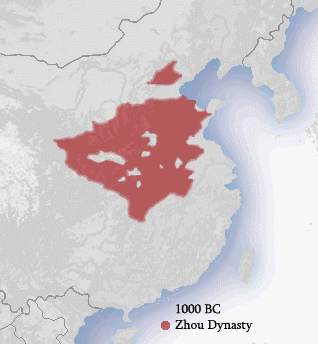
Start with the Western Zhou map. Guanzhong and Haojing lie in the west, while the Yellow River basin and the Central Plains formed the main setting for the Zhou court's ties with regional lords. Guanzhong combined the Wei River plain, defensible approaches, and routes east into the Central Plains. The larger areas on the map represent a network of enfeoffed states, not modern-style borders under direct royal administration.

Then compare the later Eastern Zhou map. After Haojing fell in 771 BCE, King Ping moved the court to Luoyi the following year. The Zhou king kept ritual standing, but powerful states increasingly set the political agenda. Together, the two maps show the shift from a royal center in Guanzhong to a competitive political world across the Central Plains.
The shortest answer is: Western Zhou was centered in Guanzhong, near modern Xi'an; Eastern Zhou was centered near Luoyang, while the wider Zhou-era world was dominated by regional states.
Why the Zhou Dynasty Cannot Be Drawn as One Fixed Border
The Zhou Dynasty was not a modern state with one stable boundary and one uniform system of direct rule. Its geography is easier to understand in three layers.
1. The royal core
During Western Zhou, the royal core was Guanzhong, with Haojing near modern Xi'an. After the eastern move, the court's core lay around Luoyi. The move preserved the dynasty, but the royal domain and practical power were much smaller than before.
2. The network of regional states
The Zhou king granted land and authority to relatives, allies, and local leaders. These regional states spread through areas that are now Shaanxi, Shanxi, Henan, Hebei, and Shandong, then reached further over time.
That is why a broad Zhou-era map should not be read as the king's directly governed territory. It often shows a political and cultural order held together by alliances, rank, ritual, and enfeoffment. For the larger story of that order, see the Zhou Dynasty guide.
3. A changing world around the court
Northern, western, and southern peoples and polities did not all answer to the Zhou court. During the Spring and Autumn and Warring States periods, states such as Qin, Qi, Chu, and the successor states of Jin expanded in different directions while the Zhou royal house lost practical control.
The key point is not to imagine the whole Zhou era as one fixed country. The court moved from Guanzhong to Luoyi, while regional powers competed across the Central Plains and neighboring regions.
What the Move East Changed
After King Wu's conquest of Shang, Haojing became the Zhou royal center. The early court also developed Luoyi as an important eastern foothold, but Guanzhong remained its base. For the dates and the Western–Eastern Zhou division, see When Was the Zhou Dynasty?.
After the court moved east, rivalry between regional states intensified. Qin ended the remaining Zhou royal house in 256 BCE, then unified the major states in 221 BCE to establish the Qin Dynasty. The Zhou's rise after the Shang Dynasty and Qin's later rise from the west make geography essential to this part of early Chinese history.
FAQ
Where was the Western Zhou capital?
Western Zhou was centered on Haojing, near present-day Xi'an in Shaanxi, within the Guanzhong region.
Where was the Eastern Zhou capital?
Eastern Zhou was centered on Luoyi, near present-day Luoyang in Henan. King Ping moved the court there in 770 BCE.
Was the whole Zhou Dynasty located in northern China?
Its royal centers and much of its early political core were in the north and the Central Plains. The wider Zhou-era world also included regional states and interactions farther south and west.
Did the Zhou king directly control all Zhou-era territory?
No. The Zhou order included many regional states with their own rulers. The king's direct power was especially limited after the move east.