Questions
How Did the Han Dynasty Use the Silk Road? Four Key Ways
The Han Dynasty used Silk Road connections first as a way to manage its northwestern frontier, not simply to sell silk to Europe. Emperor Wu sent envoys west to seek allies against the Xiongnu; the Han then secured the Hexi Corridor, maintained garrisons and messengers, and built diplomatic ties with oasis states in the Western Regions. Those links also enabled silk, horses, crops, information, and ideas to move across Eurasia through many different hands.
There is one important limit. The Han did not control one complete road called “the Silk Road.” The phrase is a modern label for several changing routes through the Hexi Corridor, the Tarim Basin, and Central Asia. For Han rulers, the value of this network was that it joined military strategy, diplomacy, and exchange in one frontier policy.
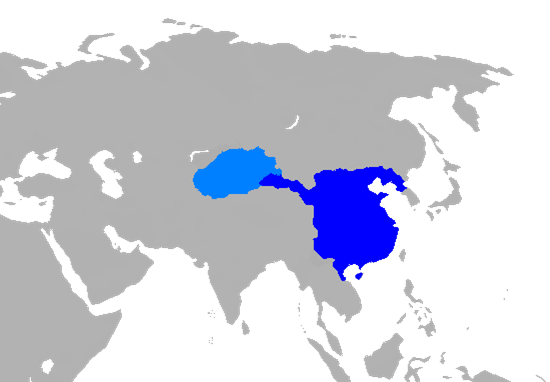
This map is not a fixed road map. It shows why the Han cared about the Hexi Corridor and the Western Regions: envoys, armies, and caravans could move west only when access to these critical areas could be maintained.
For the larger political setting, read the Han Dynasty guide. This page focuses on the narrower question of how the Han used its western connections.
How the Han Dynasty used Silk Road connections
The Han used this network in four connected ways: to seek partners against the Xiongnu, to make the route through the northwest usable, to influence politics in the Western Regions, and to exchange goods and knowledge. It was never just a commercial project or a road built and owned by Han China.
1. It sought allies against the Xiongnu
Emperor Wu sent Zhang Qian west to contact the Yuezhi, who had been defeated and displaced by the Xiongnu. The hoped-for alliance was meant to put pressure on the Xiongnu from the west. This was a military-diplomatic mission, not a merchant expedition.
Zhang Qian did not produce the alliance the Han court wanted. But he returned with information about Dayuan, the Yuezhi, Kangju, and routes through the Western Regions. The court now had a less imagined and more practical picture of what lay beyond the Xiongnu: who lived there, who might be approached, and how they could be reached.
2. It turned the Hexi Corridor into a usable frontier route
Information alone did not create a connection. After Han forces gained important ground in the Hexi Corridor during their wars with the Xiongnu, the state was better able to establish commanderies, beacon towers, postal stations, and farming-and-garrison settlements along the route.
These measures protected supplies and travelers while allowing the court to send envoys west more reliably. They did not make the frontier permanently safe. Oasis states, desert edges, and steppe zones remained contested, and travel changed with warfare, alliances, and logistics. Han control was an effort to keep a route usable in a high-risk landscape.
3. It used diplomacy to shape the Western Regions
The Han exchanged envoys, gifts, and information with the states of the Western Regions. At times it backed allies or used military pressure. The establishment of the Protectorate of the Western Regions late in Western Han shows an effort to make these relationships more continuous than occasional missions.
This was not the same as complete rule over every oasis kingdom. Local rulers retained their own interests and choices, and Han influence rose and fell. The later story of Ban Chao reopening the Western Regions shows that relations and access had to be rebuilt, not simply opened once and held forever.
4. It made trade and material exchange useful to the state
Silk was an important gift and exchange good in the Han period, but long-distance trade rarely meant a Chinese trader traveling straight to the Mediterranean. Goods commonly passed through several oasis cities, steppe intermediaries, and Central Asian caravans.
The western connection offered more than luxury objects. Fine horses mattered to Han military planning, while grapes, alfalfa, and new information about distant regions also reached the central plains. The court valued these exchanges because they affected cavalry, frontier defense, gift diplomacy, and elite consumption. Merchants and local communities found opportunities within the same wider network.
From Zhang Qian to the Western Regions Protectorate
The route was not “opened” in one moment. Over decades, reconnaissance, war, garrisons, diplomacy, and exchange became connected.
| Date | Development | Why it mattered |
|---|---|---|
| c. 139 BCE | Zhang Qian departed to seek the Yuezhi | The Han began gathering systematic information about Western Regions states and routes. |
| c. 121 BCE | Han armies made major gains in the Hexi Corridor | Travel and garrison conditions between the central plains and the northwest improved. |
| 60 BCE | The Protectorate of the Western Regions was established | The court tried to give its links and coordination in the region a more regular form. |
| Early to middle Eastern Han | Ban Chao and others restored and maintained western ties | Access required continuing diplomatic, military, and logistical work. |
One of the most important early narratives for Zhang Qian’s missions and the Western Regions is Sima Qian’s Shiji (Records of the Grand Historian), especially its account of Dayuan. It preserves how the Han court understood its diplomatic aims, but it is also a Han-era political narrative. Western Regions states were not simply passive recipients of Han policy.
What the Silk Road was not
Not one highway from Chang’an to Rome
“Silk Road” is a later shorthand for many routes and relationships. Northern and southern paths around the Tarim Basin could change, and goods and information passed from one intermediary to another. The Han helped develop the eastern part of this network and its relations with the Western Regions; it did not own a single uninterrupted international highway.
Not only a silk trade story
Silk stands out because it was useful for gifts, diplomacy, and long-distance exchange. Yet the Han court’s more immediate concerns were Xiongnu pressure, horses, frontier security, and intelligence. Treating the story only as commerce misses why the state spent troops, envoys, and supplies on western connections.
Not a permanent Han achievement
War, shifts in Xiongnu power, the choices of local states, and the imperial budget could all affect whether routes stayed open. “Opening the Silk Road” is convenient shorthand, but it should not suggest that one action settled the matter forever.
Quick reader questions
Did Zhang Qian create the Silk Road by himself?
No. Zhang Qian’s missions were pivotal because they gave the Han court systematic knowledge of the Western Regions and encouraged later contact. But oasis states, steppe routes, and regional exchange already existed. Sustaining the network depended on soldiers, envoys, merchants, and local communities.
Did the Han trade directly with Rome?
Han China and the Roman world were connected by indirect flows of goods and information, but most products passed through several regions and intermediaries. Evidence does not support imagining a regular, direct journey by merchants between the two empires.
What readers should conclude
The Han Dynasty used Silk Road connections to turn a northwestern frontier into an instrument of diplomacy, defense, intelligence, and exchange. Zhang Qian widened the court’s view; the Hexi Corridor made western movement more feasible; and the Protectorate and later campaigns tried to sustain influence. Trade followed from this process, but it was never the whole reason for it.
That is also the best way to picture the Silk Road itself: not a line made for goods alone, but a network repeatedly joined, disrupted, and rebuilt by states, cities, and communities.
FAQ
Why did the Han want access to the Western Regions?
The most immediate reason was pressure from the Xiongnu. The Han wanted allies, intelligence, and good horses, while reducing the dependence of its northwestern frontier on Xiongnu power. Trade and cultural exchange were important results.
Was Zhang Qian's mission successful?
It did not fully achieve its original goal of creating a Yuezhi alliance against the Xiongnu. Yet Zhang Qian brought back major geographical and political information, helping shape later Han engagement with the Western Regions.
Did the Protectorate of the Western Regions mean the Han ruled all of Central Asia?
No. It shows an attempt to coordinate and manage relations in the Western Regions, but oasis states retained their own political choices and Han influence changed with war, finance, and diplomacy.
Did people in the Han period call it the Silk Road?
No. The name is modern. Han people dealt with particular routes and relationships across the Hexi Corridor and the Western Regions, not with a single route bearing that later name.