Questions
Why Did the Shang Dynasty Fall? The Main Causes Behind the Collapse
Why did the Shang Dynasty fall? The short answer is that late Shang rule weakened before the final battle. Royal authority lost trust, war and ritual demands strained the center, the Zhou built power in the west, and the Battle of Muye turned a long crisis into a dynastic collapse.
The Shang fall had several main causes:
- Late Shang kingship became harder to trust.
- King Zhou of Shang became the traditional image of a failed last ruler.
- War and mobilization pressure strained the royal center.
- The Zhou grew strong enough to challenge Shang authority.
- The Battle of Muye gave the Zhou the final opening.
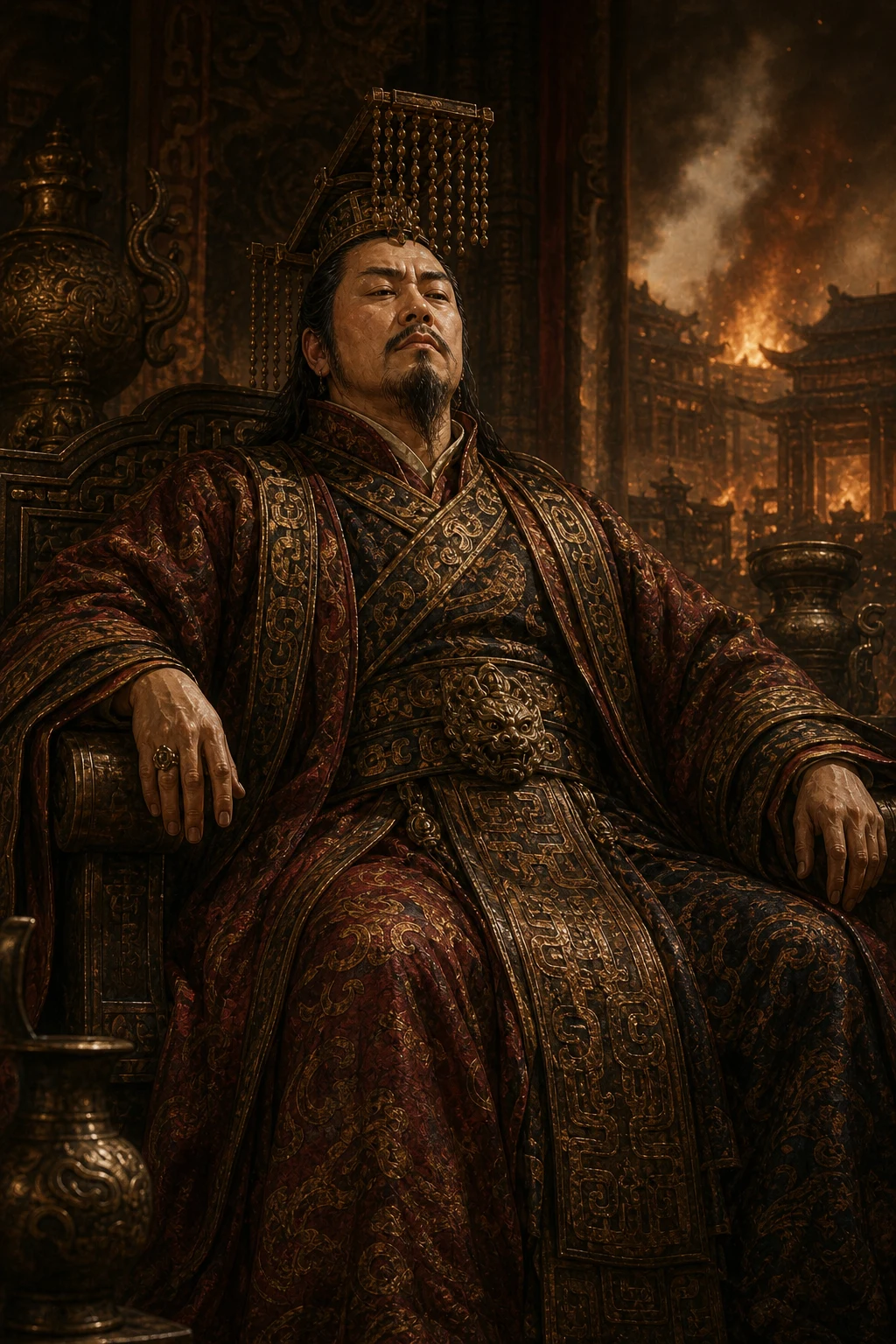
This image fits the traditional memory of the fall of the Shang Dynasty: a final ruler, a collapsing court, and a crisis later used to explain why the old royal house lost legitimacy.
How the crisis built up
The Shang Dynasty was not weak for its whole history. In the late Shang period, especially around the royal center at Yin near modern Anyang, the dynasty still had organized kingship, oracle bone divination, bronze production, ancestor ritual, and military power.
That strength also created pressure. Shang rule depended on the king's ability to command elites, organize war, perform rituals, gather resources, and keep surrounding powers inside a workable political order.
When trust in the royal center weakened, the same system became fragile. The Shang did not fall only because one ruler was bad. It fell because a stressed political system met a rising rival at the wrong moment.
For the broader background, start with Shang Dynasty. For the story-driven side of the Shang-Zhou transition, read Jiang Ziya and the Straight Hook That Waited for a New Age.
Main causes behind the fall of Shang
1. Late Shang kingship lost political trust
The Shang king was not only a political ruler. He also led ritual activity, organized warfare, dealt with ancestors through divination, and held together a network of royal relatives, nobles, warriors, and dependent groups.
That meant trust mattered. If the king could not keep major elites loyal, the dynasty's center became vulnerable.
Later tradition remembers this breakdown through stories about figures such as Weizi, Jizi, and Bigan. These stories should not be read as simple modern records of every detail, but they preserve an important memory: by the end, some people close to the Shang royal house no longer believed the center could hold.
2. King Zhou became the image of failed last rulership
King Zhou of Shang, also called Di Xin, became one of the most famous bad last rulers in Chinese historical memory. Later stories describe him as cruel, extravagant, proud, and unwilling to listen to criticism.
That image mattered because it explained the fall in moral terms. If the last Shang king had lost virtue, then the Zhou victory could be presented as more than a rebellion. It could be presented as the removal of a ruler who no longer deserved power.
But this is only one layer of the answer. The Shang did not collapse simply because King Zhou was personally bad. His image helped later writers explain the fall, while the actual collapse also depended on war pressure, elite distrust, and Zhou expansion.
3. War and mobilization pressure weakened the center
The Shang state required large-scale mobilization. Oracle bone inscriptions show royal concern with warfare, harvests, sacrifice, weather, hunting, childbirth, and ancestors. The court had to manage people, animals, bronze resources, labor, and military action.
In strong periods, that ability showed power. In a crisis, it could become a burden.
War drained manpower and attention. Ritual and elite display required resources. The royal center had to keep nobles and dependent groups aligned. If coordination weakened, a rival power could exploit the strain.
4. The Zhou grew into a serious rival
The fall of Shang is also the story of Zhou rise. The Zhou were not a tiny force that appeared suddenly at the end. They built strength in the west, developed leadership under King Wen, and waited for the right political moment.
By the time of King Wu, the Zhou could gather allies and present themselves as a real alternative to Shang rule. That is crucial for understanding the collapse.
A dynasty can have internal problems and still survive if no rival can take over. The Zhou mattered because they had enough military and political strength to turn Shang weakness into replacement.
5. The Battle of Muye became the final trigger
The Battle of Muye was the decisive final event. King Wu of Zhou marched east, met Shang forces near Muye, and defeated them. After the defeat, Di Xin returned and died by self-immolation, and Shang rule ended.
Later accounts often emphasize that Shang forces lost morale or even turned against their ruler. Whether every detail is treated literally or cautiously, the point is clear: the Shang center was not only defeated from outside. Its support had also become unstable.
Muye was not the whole cause of the fall. It was the final trigger. The dynasty had already been weakened by political distrust, military pressure, and Zhou growth. Muye turned those pressures into collapse.
Key events in the collapse
- Late Shang rule remained powerful at Yin, but it depended heavily on royal coordination, elite trust, ritual authority, and war.
- King Zhou of Shang became the traditional image of a ruler who lost virtue and political support.
- The Zhou built power in the west under King Wen and King Wu.
- The Zhou tested the political situation before committing to full conquest.
- At the Battle of Muye, King Wu defeated Shang forces, Di Xin died, and the Zhou Dynasty replaced the Shang.
These steps show why the fall should not be reduced to one battle or one bad ruler. The final event mattered because the deeper crisis had already made the Shang vulnerable.
Long-term causes vs the final trigger
The long-term causes were weakened royal trust, pressure from war and mobilization, and the rise of the Zhou as a replacement power.
The final trigger was the Battle of Muye. Without the earlier problems, Muye might have been only a battle. Because the Shang system was already under strain, Muye became the moment when the dynasty broke. That is why the Shang Dynasty collapse is best understood as both a long political crisis and a sudden military defeat.
This distinction matters for beginners. Chinese dynasties often ended through a combination of long pressure and sudden crisis. The Shang is one of the earliest examples of that pattern.
Who replaced the Shang and why that mattered
The Zhou Dynasty replaced the Shang. This was important because the Zhou did not only win by force. They also explained their victory as a moral and political transition.
In Zhou memory, the Shang king had lost the right to rule, and the Zhou had received the right to restore order. This became closely connected to the Mandate of Heaven, the idea that a ruling house could lose legitimacy if it failed to govern properly.
That makes the Shang fall much larger than one early battle. It helped shape how later Chinese history explained dynastic rise and fall.
How later tradition explained the fall
Later tradition often tells the fall as a moral story: King Zhou was cruel and corrupt, the Shang lost Heaven's support, and the virtuous Zhou replaced it.
That story is historically important because it shows how later Chinese political thought judged failed rule. But it is not the whole explanation.
A fuller answer must keep two layers together. The traditional story explains how people remembered and justified the fall. The structural explanation shows why the Shang could actually be replaced: elite distrust, resource pressure, military strain, and Zhou power had all reached a dangerous point.
What changed after the Shang fell
After the Shang fell, the Zhou established a new ruling order. The early Zhou kings had to control former Shang territories, reward allies, manage regional lords, and explain why their rule was legitimate.
This changed Chinese political memory. The Shang-Zhou transition became one of the classic examples of dynastic replacement: an old house loses support, a new house wins power, and the change is explained through virtue, order, and Heaven's approval.
Readers can place this page together with:
What readers should conclude
The Shang Dynasty fell because a weakened royal system met a prepared rival. King Zhou's bad-ruler image explains the moral memory of the fall of the Shang Dynasty, but the collapse also depended on political distrust, war pressure, Zhou expansion, and the final defeat at Muye.
If you remember one thing, remember this: the Shang fall is not just a story about a bad last king. It is an early example of how Chinese history linked system failure, military defeat, and political legitimacy into one story of dynastic change.
FAQ
Was there one single reason the Shang Dynasty fell?
No. The Shang fell because several pressures came together: weakened royal trust, war strain, elite tension, Zhou growth, and defeat at the Battle of Muye.
Did the Shang fall because King Zhou was a bad ruler?
King Zhou's bad-ruler image became central to later tradition, but the fall was not caused by his personality alone. It also involved political and military pressures.
What was the final event in the Shang collapse?
The final event was the Battle of Muye, where King Wu of Zhou defeated Shang forces. Afterward, Di Xin died and Shang rule ended.
Who replaced the Shang Dynasty?
The Zhou Dynasty replaced the Shang. The Zhou used both military victory and moral-political claims to justify the transition.
When did the Shang Dynasty fall?
The Shang Dynasty traditionally fell around 1046 BCE, when King Wu of Zhou defeated Shang forces at the Battle of Muye and the Zhou Dynasty replaced Shang rule.
How reliable is the traditional story of the Shang fall?
The traditional story is important, but it was shaped by later moral and political memory. It should be read together with broader evidence about Shang power, Zhou rise, and early state politics.