Wars
Yongjia Disaster Explained: Luoyang and Western Jin Collapse
The Yongjia Disaster was the fall and sack of Luoyang in 311 CE, when Han-Zhao forces captured the Western Jin capital and took Emperor Huai of Jin prisoner. It was not just another attack on a city. It was the moment when Western Jin central power visibly broke.
The event matters because Western Jin had recently reunited China after the Three Kingdoms, but internal civil war had already exhausted the dynasty. After Luoyang fell, Jin rule survived for a few more years in Chang'an, but the old center could not be restored.
Key Facts
- Period
- 311 CE, with the wider Western Jin collapse continuing to 316 CE
- Location
- Luoyang and its surrounding routes, later extending toward Chang'an
- Sides
- Western Jin court against Han-Zhao forces under Liu Cong and commanders such as Liu Yao, Wang Mi, and Shi Le
- Main Figures
- Emperor Huai of Jin, Liu Cong, Liu Yao, Wang Mi, Shi Le, and Sima Yue
- Typical Force Estimate
- Not a single set battle; forces shifted across siege, relief, pursuit, and regional operations
- Result
- Luoyang fell, Emperor Huai was captured, and Western Jin authority collapsed at the center
- Historical Role
- A defining disaster before the end of Western Jin and the rise of Eastern Jin in the south
Quick Answer
The Yongjia Disaster was the capture of Luoyang by Han-Zhao forces in 311 CE. Emperor Huai of Jin was taken prisoner, the capital was devastated, and Western Jin lost the political center that had held the dynasty together.
It did not legally end Western Jin on the same day. A reduced Jin court continued in Chang'an until 316 CE. But the disaster made clear that the reunified Western Jin state had already been fatally weakened.
Battle Area Map
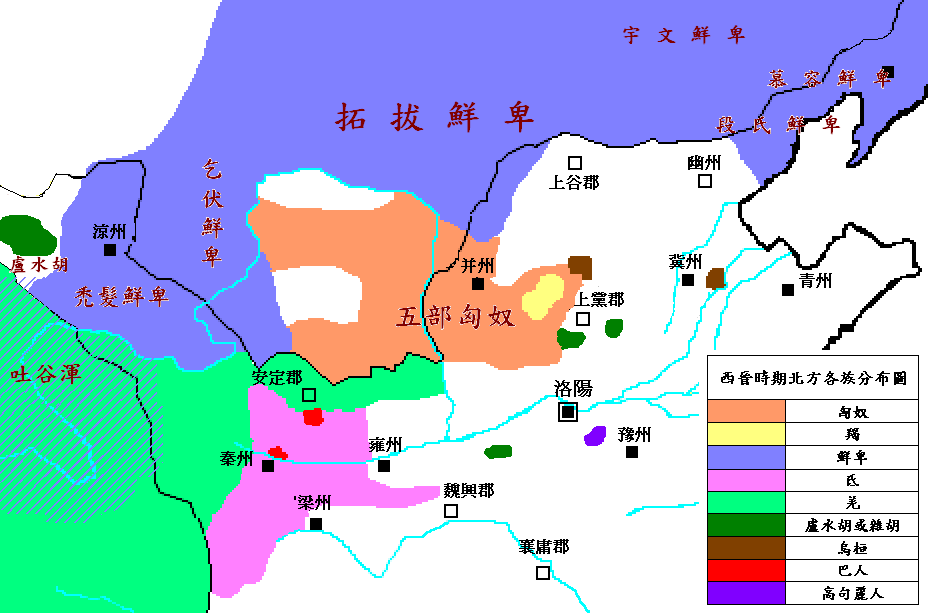
Map of northern peoples during the Western Jin period. Image by Jason22, Wikimedia Commons, public domain.
This map is not a detailed siege route map. Its value is context: Luoyang stood near the heart of Western Jin, but the north around it had already been shaken by civil war, migration, regional militarization, and rising non-Jin military powers.
What Happened
Western Jin was founded by the Sima family after it replaced Cao Wei and completed reunification by conquering Eastern Wu in 280 CE. For background on that transition, start with the Three Kingdoms guide and Sima Yi, whose family opened the road to Jin power.
Reunification did not bring lasting stability. During the War of the Eight Princes, rival Sima princes fought over the emperor, the capital, and the state. By the time that conflict ended, Western Jin had lost troops, resources, trust, and command unity.
At the same time, Han-Zhao was rising in the north. Liu Yuan had created a regime that used the name "Han" to claim legitimacy against Jin. After Liu Cong came to power, attacks on Jin territory intensified, and Luoyang became the central target.
Inside Jin, Emperor Huai tried to recover authority, but he lacked secure military control. Sima Yue, the powerful prince who had emerged from the civil wars, also distrusted the emperor. The court could not act as one body while enemy pressure increased around the capital.
Sides and Strength
Western Jin
The Jin side was formally led by Emperor Huai of Jin. He understood politics better than the earlier Emperor Hui, but he inherited a broken system.
Sima Yue had dominated the late Western Jin court after the War of the Eight Princes. His control of troops and appointments made him essential, but his conflict with the emperor weakened coordinated defense.
Han-Zhao
The attacking side belonged to Han-Zhao, ruled by Liu Cong. The forces moving against Luoyang included commanders and power-holders such as Liu Yao, Wang Mi, and Shi Le.
These figures did not form a perfectly unified modern army. They were part of a fast-changing military world in which Han-Zhao authority, personal followings, regional ambitions, and battlefield opportunity overlapped.
Why Are the Numbers Hard to Fix?
The Yongjia Disaster was not one clean battlefield encounter. It involved pressure around Luoyang, failed relief efforts, pursuit of Jin forces, collapse of supply, and the final entry into the capital.
For that reason, the safest reading is structural. The key point is not one exact troop number. It is that Western Jin no longer had the political and military strength to protect its capital, while Han-Zhao and allied or attached forces could attack from several directions.
Battle Process
1. Civil War Left Luoyang Vulnerable
The War of the Eight Princes had consumed the Western Jin ruling house from within. Armies had been raised against other Jin armies, princes had killed or removed rivals, and the capital had become a prize of factional politics.
When the civil war ended, the dynasty still existed, but its center was thin. Local commanders cared more about survival, and the court had trouble turning imperial orders into real help.
2. Han-Zhao Pressure Built Around the Capital
After Liu Cong took power, Han-Zhao continued attacks against Jin. Commanders such as Liu Yao, Wang Mi, and Shi Le operated around the north and moved pressure toward Luoyang.
The danger was not only a direct assault on the walls. Luoyang's food supply and external support were failing. A capital can survive a siege only if it can still command men, grain, and roads. Western Jin was losing all three.
3. Sima Yue Left Luoyang and Jin Forces Were Broken
Sima Yue left the capital with troops and later died while away from Luoyang. After his death, forces connected with him tried to move east with his coffin and followers.
Shi Le attacked and badly damaged this group. That blow deprived Jin of one of its last major military concentrations and left Luoyang more isolated.
4. Luoyang Fell and Emperor Huai Was Captured
In 311 CE, Han-Zhao forces entered Luoyang. The city's defenses had already been weakened by hunger, disorder, and failed coordination.
Emperor Huai attempted to flee but was captured by Liu Yao. The capture of the emperor turned military defeat into dynastic humiliation. Western Jin no longer looked like a functioning center of rule.
5. Chang'an Survived Briefly, Then Fell
After Luoyang fell, Western Jin did not disappear immediately. Sima Ye was later enthroned in Chang'an as Emperor Min of Jin.
That final court was weak and isolated. In 316 CE, Liu Yao captured Chang'an, Emperor Min surrendered, and Western Jin came to an end.
Result
The direct result of the Yongjia Disaster was the fall of Luoyang and the capture of Emperor Huai. The capital was devastated, court authority collapsed, and the dynasty lost its most important political center.
The wider result was the breakup of northern Jin order. Chang'an kept the Jin name alive for a few years, but it did not restore a stable empire.
The social result was just as important. Elite families and ordinary people moved south in large numbers. That movement helped make the lower Yangzi region a new political center and prepared the ground for Eastern Jin rule from Jiankang.
Why It Matters
1. It Marked the Collapse of Western Jin's Center
The War of the Eight Princes weakened Western Jin from inside. The Yongjia Disaster destroyed the capital's authority from outside and turned weakness into visible collapse.
2. It Pushed North China Into a New Age of Division
After Luoyang fell, north China was no longer simply a disturbed Jin frontier. Han-Zhao, Later Zhao, Former Zhao, and other regimes fought for control, opening the broader Sixteen Kingdoms phase.
3. It Helped Create Eastern Jin
The southward movement of people and political authority made Eastern Jin possible. The Sima house survived, but no longer as a northern reunified dynasty. It survived by rebuilding around southern elites and the city of Jiankang.
Readers who want the bigger chronological frame can place this event in the Chinese Dynasties Timeline. For the internal collapse that came first, read War of the Eight Princes.
Timeline
Timeline
280 CE
Western Jin conquered Eastern Wu and reunited China after the Three Kingdoms
291-306 CE
The War of the Eight Princes weakened Western Jin from inside
304 CE
Liu Yuan rose and formed the basis of Han-Zhao power
310 CE
Liu Cong seized power after Liu Yuan's death and continued war against Jin
311 CE
Sima Yue died away from Luoyang, and Jin forces connected with him were badly damaged by Shi Le
311 CE
Han-Zhao forces captured Luoyang and took Emperor Huai prisoner
313 CE
Emperor Huai was killed in captivity at Pingyang
316 CE
Chang'an fell, Emperor Min surrendered, and Western Jin ended
Source Note
The traditional outline of the Yongjia Disaster comes especially from the Book of Jin and later chronological histories such as the Zizhi Tongjian. These sources preserve the main sequence of Luoyang's fall, but modern readers should treat exact massacre numbers, personal motives, and moral blame with caution.
Related Pages
FAQ
FAQ
When was the Yongjia Disaster?
The Yongjia Disaster usually refers to the fall of Luoyang in 311 CE, during the reign of Emperor Huai of Western Jin.
Who captured Luoyang in the Yongjia Disaster?
Luoyang was captured by Han-Zhao forces under the wider rule of Liu Cong, with commanders such as Liu Yao, Wang Mi, and Shi Le involved in the surrounding military collapse.
Was the Yongjia Disaster the end of Western Jin?
Not immediately. Western Jin continued in Chang'an until 316 CE, but the fall of Luoyang destroyed the old political center and made recovery extremely difficult.
How was the Yongjia Disaster connected to the War of the Eight Princes?
The War of the Eight Princes weakened Western Jin's court, armies, and authority. The Yongjia Disaster happened after that internal damage left Luoyang exposed.
Why is the Yongjia Disaster important?
It marked the collapse of Western Jin's central authority, accelerated north China's division, and helped push the Jin ruling house and many northern elites south toward Eastern Jin.