Comparisons
Xia vs Shang Marriage Systems: Evidence, Kinship, and Alliances
Marriage in both Xia and Shang was connected to kinship, succession, and political alliance. The decisive difference is evidence: Xia marriage practices can only be reconstructed cautiously from later texts and archaeological debate, while late Shang oracle bones, tombs, and bronzes reveal more about royal women, kinship, and marriage.
Quick Answer
The Xia cannot be reconstructed as a single, complete marriage code. Marriage likely helped organize royal descent, alliances among groups, and succession, but the rules for choosing a spouse, the status of different partners, and everyday practice remain largely unknown.
The Shang leaves richer material. Oracle bones and archaeology show that royal marriages, female relatives, sacrifice, succession, and regional relationships were connected. Yet the exact balance of endogamy and exogamy, or of monogamy and multiple spouses, remains debated; later Chinese ritual rules cannot supply a simple answer for the Shang.
Xia vs Shang Marriage Systems at a Glance
| Theme | Xia Marriage Systems | Shang Marriage Systems |
|---|---|---|
| Evidence | Known mainly through later texts, traditional memory, and archaeological debate | Late Shang oracle bones, tombs, and bronzes make more royal and kinship relationships visible |
| Political role | May have supported royal descent, group alliances, and succession | Connected royal continuity with sacrifice, regional powers, and political networks |
| Marriage boundaries | No contemporary texts allow a uniform rule of permitted or forbidden marriages to be reconstructed | Kin groups, descent lines, and marriage links can be studied, but the exact scope of endogamy and exogamy remains debated |
| Wives and other partners | Later narratives cannot reliably reconstruct a stable hierarchy | Oracle-bone texts contain several female and kinship terms, but they should not be equated automatically with later wife-concubine categories |
| Women's roles | The evidence is too thin to map royal women's political activity systematically | Royal women are more visible in ritual, production, warfare, and estate affairs |
| Level of certainty | Best described cautiously as an early kinship-based marriage order | Allows more detailed study, but still cannot be reduced to Zhou or later ritual rules |
Key Facts
- Comparison
- Xia and Shang marriage, kinship, and political alliance
- Main difference
- The Shang has more contemporary evidence; Xia institutions must be discussed more cautiously
- Xia focus
- Royal descent, group alliance, and the gap between texts and archaeology
- Shang focus
- Oracle bones, royal women, sacrifice, kinship, and regional networks
- Reading warning
- Do not project Zhou same-surname marriage rules, primogeniture, or later concubinage categories backward onto Xia and Shang
Evidence note: This page compares how far the evidence lets us see marriage and kinship within early politics. It does not invent a later-style marriage law for either dynasty. Oracle-bone research covers late Shang royal structure, lineage, and marriage-related material, but the meaning of terms for women, descent lines, and marriage patterns remains disputed.
Why Is a Direct Comparison Difficult?
“Marriage system” can suggest later rules about age, betrothal gifts, divorce, or a fixed marriage form. For Xia and Shang, better questions come first: who could marry whom, how did marriage organize kinship, and how did it affect succession, sacrifice, and alliances?
The evidence is uneven. For the Xia Dynasty, researchers must separate later narrative, Erlitou-related archaeology, and what can actually be claimed about institutions. For the Shang Dynasty, oracle bones and Yinxu materials make the questions more concrete, but they still reflect late Shang royal and elite worlds more clearly than every region and social group.
Xia: What Can and Cannot Be Said?
Traditional accounts place the Xia at the beginning of hereditary kingship. If royal power was to remain within a ruling house, marriage would have mattered for descent, succession, and alliance. It is therefore reasonable to treat Xia marriage as part of early kinship politics.
That does not mean that we know a fixed Xia rule against same-surname marriage, a stable hierarchy of wives and secondary partners, or a full wedding procedure. Clearer ritual formulas survive from later periods. The safer conclusion is that marriage mattered, while its detailed institutions cannot be restored. For the limits of the evidence, see Was the Xia Dynasty Real? Evidence and Debate.
Shang: Why Are Marriage and Kinship More Visible?
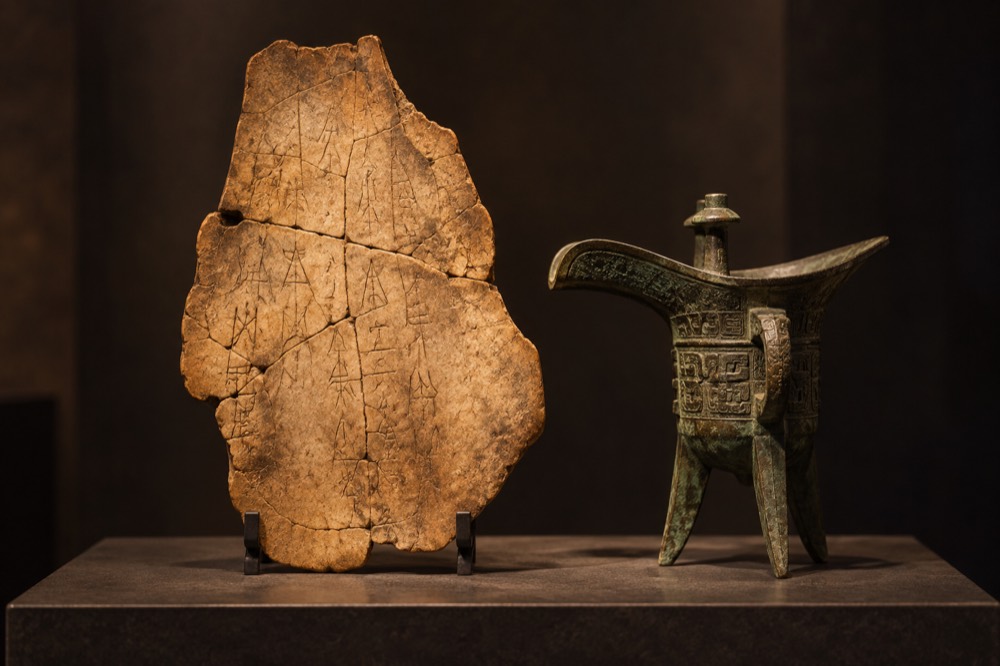
Late Shang oracle-bone inscriptions concern royal structure, lineage, marriage, and daily life. They offer more direct evidence for marriage and kinship than is available for the Xia. An overview of oracle-bone research from China's National Office for Philosophy and Social Sciences likewise notes that the inscriptions cover royal structure, lineage, and marriage-related activity.
The evidence shows that marriage was not merely a private matter. It was entangled with royal women, ancestor sacrifice, children, regional relationships, and political networks. Fu Hao, for example, makes the role of one royal woman in ritual, warfare, and estate affairs unusually visible. Her case should not be generalized into a claim that all Shang women held the same power.
Even the relationship between oracle-bone terms such as fu and formal marital status remains open to interpretation. Research on these terms compares female kinship labels with royal, child, and social roles, which is precisely why the Shang has more evidence without a single uncontested model. See this Tsinghua University research summary on the Shang term fu.
How Did Marriage Support Political Alliances?
Xia and Shang were not later bureaucratic states. Royal houses relied both on kin groups and on relationships with other communities, and marriage was likely one way to build such ties.
For the Xia, marriage alliances between groups should be treated as a useful interpretation, not a list of proven rules. For the Shang, richer evidence about the royal house, nobles, regional powers, and female relatives makes it easier to discuss how marriage could be woven into sacrifice, succession, and political networks.
This is the boundary between this page and Xia Dynasty vs Shang Dynasty Government: Key Differences. The government page compares how royal power operated; this page focuses on how marriage and kinship participated in early political organization.
Do Not Project Zhou Ritual Rules Backward
Readers often summarize early Chinese marriage with terms such as same-surname marriage bans, primogeniture, or one wife plus concubines. Those ideas can help explain later ritual development, but they should not be treated automatically as uniform Xia or Shang rules.
In particular, scholars disagree about Shang endogamy, exogamy, descent-line divisions, and partner relationships. The most reliable comparison is not a single formula for both dynasties. It is this: Shang materials allow more questions to be asked in detail, while Xia requires larger evidential gaps to remain visible.
FAQ
FAQ
What was the main difference between Xia and Shang marriage systems?
The main difference is evidence. Xia marriage rules can only be inferred cautiously from later texts and archaeological debate. Late Shang oracle bones, tombs, and bronzes make royal women, kinship, sacrifice, and marriage-related questions easier to study.
Were Xia and Shang both monogamous?
That cannot be stated simply. Xia evidence is too thin to confirm a stable marriage form, and Shang partner structures, wife-concubine categories, and kinship terms remain debated. Later formulas should not be treated as a uniform rule for the whole Xia-Shang period.
Did the Shang practice endogamy or close-kin marriage?
Shang descent lines, marriage boundaries, and endogamy are debated research questions. Oracle bones provide kinship evidence, but scholars do not interpret every term, lineage, and actual marriage pattern in the same way. A single yes-or-no answer would oversimplify the Shang world.
Does Fu Hao prove that Shang women had high status?
Fu Hao shows that one royal woman could play major roles in sacrifice, warfare, and estate affairs. Her case is valuable evidence, but it does not prove that all Shang women had the same authority or social position.
Why should Zhou marriage rules not be used to explain Xia and Shang?
Zhou sources preserve a more systematic ritual vocabulary, while Xia and Shang evidence has a different form and coverage. Projecting Zhou same-surname bans, primogeniture, or partner hierarchies backward can mistake later rules for institutions already fully formed in earlier periods.