Dynasties
Han Dynasty Guide: Rise, Government, Timeline, and Legacy
The Han Dynasty was the major imperial dynasty that followed the Qin Dynasty. It is usually dated from 202 BCE, when Liu Bang became emperor, to 220 CE, when Cao Pi replaced the last Eastern Han emperor.
The Han deserves a standalone guide because it turned early imperial China from a fragile experiment into a durable political tradition. Its story includes recovery after civil war, frontier expansion, Confucian learning at court, Silk Road contact, court factionalism, rebellion, and the road toward the Three Kingdoms.
Key Facts
- Period
- 202 BCE-220 CE, with a Xin interruption from 9 to 23 CE
- Founder
- Liu Bang, later Emperor Gaozu of Han
- Main Phases
- Western Han, Xin interruption, Eastern Han
- Capital
- Chang'an in Western Han, Luoyang in Eastern Han
- Capital Site Today
- Chang'an near Xi'an, Shaanxi; Luoyang in Henan
- Known For
- Imperial government, Confucian state culture, frontier expansion, Silk Road contact, and Chinese identity
- Historical Role
- A foundational model for later Chinese imperial rule
- Preceded By
- Qin Dynasty and the Chu-Han struggle
- Succeeded By
- Three Kingdoms period
What Was the Han Dynasty?
The Han Dynasty was an early imperial dynasty of China founded by Liu Bang after the Chu-Han struggle. Strictly speaking, Western Han begins when Liu Bang became emperor in 202 BCE, but the political name "Han" had already appeared in 206 BCE when he was made King of Han.
The dynasty was not one smooth block of history. It had two main Han phases: Western Han, centered on Chang'an, and Eastern Han, centered on Luoyang. Between them came Wang Mang's Xin regime, a short-lived dynasty that interrupted Han rule from 9 to 23 CE.
For beginners, the Han is one of the first dynasties to understand after Qin. Qin created the first empire; Han showed how that empire could be adjusted, softened, expanded, and made memorable.
Western Han vs Eastern Han
Western Han and Eastern Han were both part of the Han Dynasty, but they were not the same political situation repeated twice. Western Han began after Liu Bang defeated Xiang Yu and built a new order from the ruins of Qin and civil war. Its main problem was how to keep a unified empire stable without repeating Qin's severity.
Eastern Han began after Wang Mang's Xin regime collapsed. Liu Xiu, Emperor Guangwu of Han, had to restore the Han name after rebellion, famine, and rival regimes had broken the realm apart. That is why Eastern Han is often better understood as a restoration, not a direct continuation without interruption.
The two phases also ended differently. Western Han was replaced from inside the court by Wang Mang. Eastern Han ended after local military commanders and powerful ministers hollowed out imperial authority, making the Three Kingdoms world real before the final abdication in 220 CE.
Why the Han Dynasty Matters
The Han matters because it made unified empire last. Qin had unified the realm but collapsed quickly. Han kept much of Qin's administrative framework while reducing some early pressures and building a wider base of loyalty.
It also matters because it helped shape elite political culture. Confucian classics became increasingly important in court language, official recommendation, education, and ideas about good rule. This did not remove law, taxation, punishment, military power, or imperial authority, but it gave the state a more moral and classical vocabulary.
The dynasty also left a deep cultural name. Later terms such as Han people, Han language, and Han characters show that the dynasty's name became more than a ruling house. It became part of how later Chinese identity was remembered and described.
Historical Background
Before the Han, the Qin had unified the Warring States world and created the emperor title, commandery-county administration, standardized systems, and a hard-edged imperial state. But Qin rule was severe, and after Qin Shi Huang died, court crisis and rebellion destroyed the dynasty.
When Qin fell, Xiang Yu divided the realm and made Liu Bang King of Han. The result was not peace. Xiang Yu and Liu Bang fought for supremacy in the Chu-Han Contention, a struggle that decided whether the post-Qin world would remain fragmented or return to unified empire.
Liu Bang's victory meant that the imperial idea survived Qin's collapse. The new dynasty inherited Qin's problem: how could one ruler govern a vast territory without making the state so harsh that it broke again?
Rise of the Han Dynasty
The rise of Han began with Liu Bang's ability to survive and adapt. He came from a modest background, but he built alliances, used talented advisers and generals, and outlasted stronger-looking rivals.
After defeating Xiang Yu, Liu Bang became emperor in 202 BCE. In How Liu Bang Founded the Western Han Dynasty, the new ruler still had to choose a capital, manage powerful ministers, and turn a wartime coalition into a working empire.
Early Han rulers did not simply copy Qin. They kept commanderies, counties, written administration, taxes, and official ranks, but they also used lighter policies and some regional kingdoms to stabilize the postwar world. This balance gave the dynasty room to recover, though it also created future conflict between the central court and powerful kings.
Territory Map
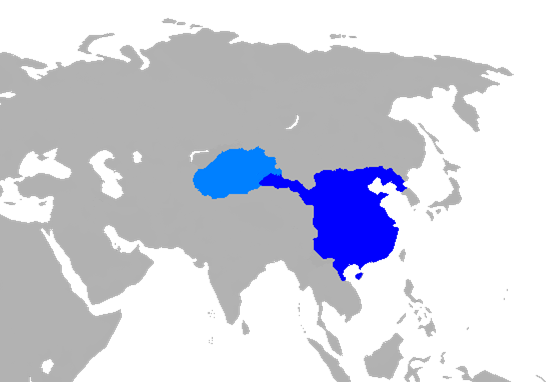
This map shows the Han world around 2 CE, near the end of Western Han. The darker areas show direct Han administration, while the lighter western areas show protectorate influence connected with the Western Regions.
Han territory did not begin at this scale. It grew through early recovery, campaigns under Emperor Wu, control of the Hexi Corridor, management of the Western Regions, and later Eastern Han attempts to reopen frontier influence.
Han Dynasty Timeline
Timeline
206 BCE
Liu Bang becomes King of Han
After Qin falls, Xiang Yu assigns Liu Bang to Han, giving the dynasty its political name.
202 BCE
Founding of the Western Han Dynasty
Liu Bang defeats Xiang Yu, becomes emperor, and begins rebuilding unified rule.
180-141 BCE
Rule of Wen and Jing
Early Han recovery deepens through lighter taxation, reduced punishments, and social rebuilding.
154 BCE
Rebellion of the Seven States
The court defeats rebellious regional kings and strengthens central authority.
141-87 BCE
Reign of Emperor Wu
Emperor Wu expands imperial power, fights the Xiongnu, promotes court learning, and pushes Han influence outward.
60 BCE
Protectorate of the Western Regions
Western Han builds more formal links with oasis states and routes toward Central Asia.
9-23 CE
Wang Mang and the Xin interregnum
Wang Mang replaces Western Han, launches reforms, and collapses during crisis and rebellion.
25 CE
Eastern Han restoration under Liu Xiu
Liu Xiu restores Han rule and establishes the Eastern Han capital at Luoyang.
184 CE
Yellow Turban Rebellion
A major uprising exposes late Han weakness and increases the power of regional commanders.
220 CE
End of Han rule
Cao Pi receives the abdication of Emperor Xian and founds Cao Wei.
What Happened During the Han Dynasty?
The Han story is best read in three layers: Western Han, the Xin interruption, and Eastern Han. Western Han solved the problem of rebuilding empire after Qin; Eastern Han solved the problem of restoring Han legitimacy after Wang Mang; late Eastern Han shows how court conflict and regional military power could empty the dynasty from within.
Western Han began with Liu Bang's victory over Xiang Yu. The new emperor kept the direction of unified rule, but he also lowered some pressures after years of Qin collapse and civil war. He settled at Chang'an, managed meritorious ministers, reduced the danger of semi-independent military strongmen, and used both commanderies and kingdoms to hold the realm together.
The early dynasty then moved through the regency of Empress Lu and the rule of Emperor Wen and Emperor Jing. Their lighter policies helped people recover from war, while the court slowly dealt with regional kings who had become too powerful. The Rebellion of the Seven States in 154 BCE was a turning point because its defeat allowed the central court to restrict kingdom power more firmly.
Under Emperor Wu of Han, Western Han shifted from recovery to expansion. The court fought long wars against the Xiongnu, pushed into the Hexi Corridor, sent Zhang Qian toward the Western Regions, and developed stronger fiscal measures to support military campaigns. These moves made Han one of the major classical empires, but they also raised the cost of rule.
Emperor Wu's reign also strengthened the place of classical learning at court. Confucian scholars and texts gained status, though Han government remained a mix of moral language, legal administration, fiscal control, and imperial command. Sima Qian's Shiji, or Records of the Grand Historian, also belongs to this world and became one of the most important works of Chinese historical writing.
Western Han did not pass smoothly into Eastern Han. In the late Western Han, the Wang family rose through the court, and Wang Mang gradually turned reputation, regency, ritual, and claims of heavenly favor into political power. In 9 CE he replaced Han with Xin, but his ambitious reforms of land, money, offices, and social order failed amid disaster and rebellion.
The failure of Xin created another age of war. Liu Xiu, a member of the Liu clan, rebuilt Han legitimacy through military victory and political patience. In How Emperor Guangwu Restored Order in the Eastern Han, his rule is shown as a second founding: he reduced burdens, released dependents, restored legal order, and tried to let people return to fields and households after years of chaos.
Eastern Han was not simply a weak afterlife of Western Han. Its early rulers restored order, governed from Luoyang, reopened western routes, and still projected power along the frontier. Figures such as Ban Chao show that Eastern Han could remain active beyond the central plains.
Over time, however, Eastern Han politics became trapped in a cycle. Child emperors brought empress dowagers and maternal relatives into power; adult emperors often turned to eunuchs to break those relatives; scholars and officials grew angrier as appointments and law became tied to private factions. The Partisan Prohibitions showed that conflict between scholar-officials and palace power had become severe.
By the late second century, social pressure, land concentration, disaster, and religious movements fed unrest. The Yellow Turban Rebellion in 184 CE was suppressed, but the cost was enormous: the court had to rely on provincial officials and military commanders. Those commanders gained real power that the central government could no longer easily take back.
After the rebellion, the dynasty still had an emperor, but authority moved elsewhere. Dong Zhuo entered the capital, controlled the court, and shattered what remained of central trust. Cao Cao later held Emperor Xian and used Han legitimacy, but the state was already dominated by regional power. In 220 CE, Cao Pi replaced Han with Cao Wei, and the Three Kingdoms order became formal.
Capitals
Western Han used Chang'an as its capital. Chang'an stood near modern Xi'an in Shaanxi and gave the early dynasty access to the Guanzhong region, a strategic base already important under Qin.
Eastern Han used Luoyang as its capital. Luoyang stood in the Central Plains and suited Liu Xiu's restored regime, which had to reconnect Guanzhong, the east, and the wider empire after the collapse of Xin.
The simplest rule is clear: Western Han means Chang'an; Eastern Han means Luoyang. Wang Mang's Xin regime also used Chang'an, but Xin was an interruption rather than a normal Han phase.
Government and Administration
Han government centered on the emperor, but it depended on officials, documents, local administration, taxation, military structures, and court institutions. The state inherited many Qin tools but used them with more flexibility.
Early Han used a mixed system of commanderies and kingdoms. Commanderies were governed through appointed officials, while kingdoms were granted to royal relatives. This helped stabilize the early dynasty, but powerful kingdoms later threatened the center.
After the Rebellion of the Seven States, the court kept reducing kingdom power. Under Emperor Wu, policies such as dividing inheritance among royal sons made kingdoms smaller and less able to challenge the throne.
Han official recruitment also helped connect learning and government. The recommendation system, including categories such as filial and incorrupt, was not the later civil service examination, but it gave educated and reputable men a path into office.
Confucianism became more important in this official world, especially as a language of ritual, moral judgment, and political legitimacy. Still, Han rule was never simply "Confucian government." Law, punishment, fiscal policy, military command, and imperial authority remained central.
Economy and Society
Han society was mainly agricultural. Most people lived in villages, farmed land, paid taxes, and owed labor or military service to the state.
Early Western Han recovery depended on reducing burdens after long warfare. The memory of Emperor Wen and Emperor Jing became associated with lighter taxation, fewer harsh punishments, and social restoration.
Expansion under Emperor Wu required more resources. State monopolies, transport policies, coinage controls, and pressure on powerful families all helped fund campaigns and frontier strategy. These policies made the state stronger, but they also created tension.
Local powerful families became increasingly important, especially in Eastern Han. They controlled land, dependents, local networks, and access to office. In stable times they helped govern; in crisis they weakened the court's direct control.
Han Dynasty and the Silk Road
The Han Dynasty did not create one single road called the Silk Road. What it did was help make long-distance exchange across Inner Asia more active, more politically visible, and more connected to Chinese imperial strategy.
Zhang Qian's missions under Emperor Wu gave the court better knowledge of the Western Regions, including oasis states, steppe powers, and routes toward Central Asia. The original military goal was tied to the Xiongnu, but the long-term result was a broader frontier vision.
Control of the Hexi Corridor mattered because it opened a safer passage from the Chinese heartland toward the northwest. When Western Han later established the Protectorate of the Western Regions, the court was not only trading silk. It was trying to manage diplomacy, security, envoys, military pressure, and access to oasis routes.
This is why the Han connection to the Silk Road should be read as political as well as commercial. Goods moved, but so did information, envoys, horses, technologies, religious ideas, and stories about distant peoples.
Culture, Religion, and Ideas
Han culture included Confucian learning, legal administration, Huang-Lao ideas, omen interpretation, court ritual, local beliefs, and imperial searches for cosmic legitimacy. It was intellectually mixed, not one-note.
The rise of Confucian classics is still one of the dynasty's most important changes. These texts gave officials a shared language for discussing rule, virtue, hierarchy, and ritual order. Later dynasties would continue to treat classical learning as a core part of elite government.
Historical writing also became a major Han legacy. Sima Qian's Shiji gave later readers a powerful way to understand rulers, ministers, rebels, and dynastic change. Ban Gu's Hanshu, or Book of Han, later turned Western Han history into a dynastic history model.
Technology and scholarship also mattered. Eastern Han figures such as Zhang Heng and Xu Shen are remembered for astronomy, mechanics, and the study of writing. Paper, traditionally associated with improvements under Cai Lun in Eastern Han, also became one of the period's most famous contributions.
Major Achievements and Projects
- Durable imperial rule: Han made the unified empire last far longer than Qin.
- Wen-Jing recovery: early Western Han reduced burdens and rebuilt society after war.
- Centralization after rebellion: the court weakened regional kingdoms and strengthened appointed administration.
- Emperor Wu's expansion: Han power moved north, northwest, south, and toward the Western Regions.
- Western Regions contact: Zhang Qian, the Hexi Corridor, and the protectorate linked Han policy to long-distance exchange.
- Confucian state culture: classical learning became deeply tied to office, court language, and legitimacy.
- Historical writing: Shiji and Hanshu shaped how later generations wrote and read Chinese history.
- Eastern Han restoration: Liu Xiu rebuilt Han rule after Xin collapse and gave the dynasty a second life.
Decline and Fall
The Han did not decline for one simple reason. Western Han and Eastern Han ended in different ways.
Western Han was replaced from inside the court. The Wang family rose through marriage politics and regency power, and Wang Mang used ritual, reputation, and reformist claims to take the throne. His Xin regime then failed because its reforms were too disruptive, crisis was too severe, and loyalty to Han had not disappeared.
Eastern Han declined through a different pattern. Child emperors, empress dowagers, maternal relatives, eunuchs, scholar-official conflict, local powerful families, land concentration, and weak central command all interacted over time.
The Yellow Turban Rebellion did not instantly end Han, but it changed the balance of power. Regional commanders gained armies and territory while the court lost practical control. Once Dong Zhuo entered the capital and later warlords competed across the realm, Han authority became more symbolic than real.
In 220 CE, Cao Pi forced Emperor Xian to abdicate and founded Cao Wei. That act formally ended the Han Dynasty, but the political world of the Three Kingdoms had already been forming for decades.
Was the Han Dynasty a Golden Age?
The Han Dynasty is often remembered as one of China's great historical high points, and that reputation is understandable. It lasted for centuries, expanded imperial reach, strengthened state institutions, supported major works of history and scholarship, and left a name that later became central to Chinese identity.
But calling it a golden age can hide the cost of that success. Han power depended on taxation, labor, military campaigns, court politics, and frontier pressure. Emperor Wu's expansion brought prestige, but it also demanded heavy resources. Eastern Han restoration brought order, but its later politics became deeply unstable.
So the safest answer is balanced: the Han was a major high point in Chinese history, but not a simple age of peace and prosperity from beginning to end. Its importance comes from both its achievements and the problems it revealed about long-term imperial rule.
Legacy
The Han legacy is one of the deepest in Chinese history. It made the unified empire feel durable, adaptable, and worth remembering as a model.
Politically, later dynasties looked back to Han institutions, warnings, and precedents. The dynasty showed how commanderies, kingdoms, officials, recommendation, frontier policy, court learning, and powerful families could work together or pull against one another.
Culturally, the name Han became central to identity. It attached itself to people, language, script, and historical memory. That is why the Han Dynasty remains more than one dynasty in a chronological list.
For readers who want the ruler order rather than the full overview, the Han Dynasty Emperors Timeline gives a cleaner sequence of Western Han and Eastern Han emperors.
Important Rulers and Figures
- Liu Bang | Founder of Western Han and the first Han emperor.
- Empress Lu | A powerful early regent who showed how deeply relatives could enter Han politics.
- Emperor Wen of Han | A ruler associated with lighter government and early recovery.
- Emperor Jing of Han | The emperor whose reign saw the Rebellion of the Seven States defeated.
- Emperor Wu of Han | The major expansionist ruler who strengthened imperial power and frontier strategy.
- Wei Qing and Huo Qubing | Generals whose campaigns helped change the balance against the Xiongnu.
- Zhang Qian | Envoy whose missions opened Han knowledge of the Western Regions.
- Sima Qian | Historian whose Shiji reshaped Chinese historical writing.
- Huo Guang | Powerful regent who influenced succession and Western Han recovery after Emperor Wu.
- Emperor Xuan of Han | A Western Han ruler linked with renewed stability after earlier court strains.
- Wang Mang | Usurper who ended Western Han and founded the short-lived Xin regime.
- Liu Xiu, Emperor Guangwu | Restorer of Han rule and founding emperor of Eastern Han.
- Ban Chao | Eastern Han frontier commander associated with renewed Western Regions influence.
- Emperor Ling of Han | Late Eastern Han emperor whose reign saw deepening crisis before the Yellow Turban Rebellion.
- Emperor Xian of Han | Last Han emperor, controlled by warlords before the final abdication.
Evidence and Source Notes
This guide follows the standard historical dating used in most reference works: Western Han begins with Liu Bang's imperial accession in 202 BCE, while the name Han can be traced back to his title as King of Han in 206 BCE. It treats Wang Mang's Xin as an interruption, not as a normal Han phase.
For Western Han narrative, the most important traditional sources include Sima Qian's Shiji and Ban Gu's Hanshu. For Eastern Han, later dynastic histories such as the Hou Hanshu preserve much of the political narrative. These works are essential, but they also reflect court-centered historical writing, so this page avoids presenting motives, omens, and moral judgments as simple facts.
The territory map is a modern reconstruction of Han control and protectorate influence around 2 CE. It should be read as a guide to broad political geography, not as a precise border map in the modern sense.
FAQ
When did the Han Dynasty rule China?
The Han Dynasty is usually dated from 202 BCE to 220 CE. The Han royal title began in 206 BCE, and Han rule was interrupted by Wang Mang's Xin regime from 9 to 23 CE.
Who founded the Han Dynasty?
Liu Bang founded the Han Dynasty. After defeating Xiang Yu in the Chu-Han struggle, he became emperor in 202 BCE and is remembered as Emperor Gaozu of Han.
What is the Han Dynasty best known for?
The Han is best known for durable imperial government, the rise of Confucian state culture, expansion under Emperor Wu, contact with the Western Regions, and its long influence on Chinese identity.
Was the Han Dynasty a golden age?
It can be called a major high point, but with caution. The Han produced durable institutions, expansion, scholarship, and cultural influence, yet it also faced heavy military costs, court factionalism, social pressure, rebellion, and eventual collapse.
What is the difference between Western Han and Eastern Han?
Western Han was centered on Chang'an and began after Liu Bang founded the dynasty. Eastern Han was centered on Luoyang and began when Liu Xiu restored Han rule after the collapse of Wang Mang's Xin regime.
Why did the Han Dynasty fall?
Western Han ended when Wang Mang replaced it from within the court. Eastern Han ended after court factionalism, local elite power, rebellion, and regional military commanders weakened central authority; in 220 CE, Cao Pi replaced Han with Cao Wei.
What came after the Han Dynasty?
After Han rule ended, China entered the Three Kingdoms period. Cao Wei, Shu Han, and Eastern Wu became the main rival states.