Questions
How Did Qin Shi Huang Unify China? The Conquest of Six States
Qin Shi Huang unified China by using the armies and resources of the state of Qin to conquer six rival states. The final campaigns began with Han in 230 BCE and ended with Qi in 221 BCE. Qin's victory ended the Warring States period and established the first Chinese empire.
The future emperor was then King Zheng of Qin. He inherited a powerful state built up by earlier rulers and advisers; generals and officials carried out the campaigns and organized the new empire under his authority.
Before the final campaigns
The Warring States were rival kingdoms in a region corresponding to parts of present-day China. Qin lay to their west. For generations, Qin and its rivals fought, expanded and formed alliances. Qin's earlier conquests and reforms helped it mobilize soldiers, food and officials before Zheng became king in 246 BCE.
Shang Yang's reforms, more than a century before unification, strengthened state control and rewarded military service. They were part of a longer history of change, not a single invention that guaranteed victory. A study of Qin logistics examines the resources and transport needed to sustain the final wars.
How Qin defeated the six states
Qin's armies did not conquer all six rivals at once. They attacked in successive campaigns, while diplomacy and rivalry among the states shaped their opportunities. The years below identify major victories or the end of surviving royal regimes; some campaigns lasted longer than one year.
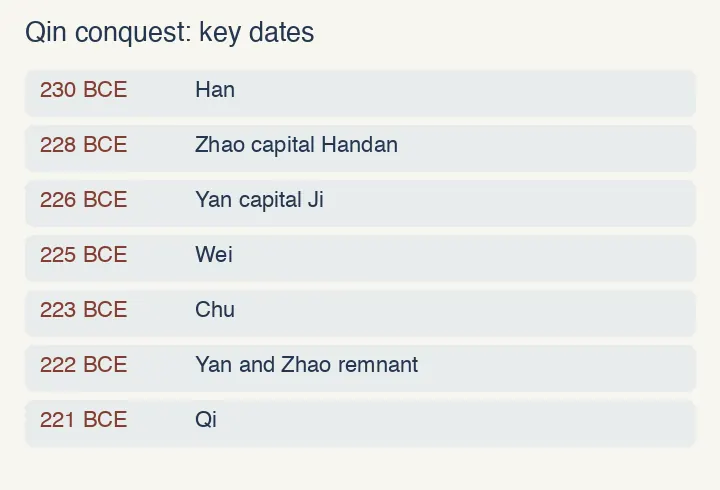
- Han, 230 BCE: Qin annexed the neighboring state of Han, opening the final series of conquests.
- Zhao, 228 and 222 BCE: Qin captured Zhao's capital Handan and its king in 228. A surviving Zhao regime held out farther north until 222.
- Wei, 225 BCE: Qin took Wei's capital Daliang after a siege in which the city was flooded.
- Chu, 223 BCE: Qin defeated the large southern state after a difficult campaign; an earlier Qin assault had failed.
- Yan, 222 BCE: Qin had taken Yan's capital Ji in 226, but Yan's ruler continued resistance in the northeast until 222.
- Qi, 221 BCE: Qin's forces reached the eastern state of Qi, whose king surrendered. The last of the six rival kingdoms had fallen.
The conquest order is clearer when the fall of a capital is separated from the end of a surviving court. Oxford's account of unification identifies Han as the first state to fall and Qi as the last; Harvard's ChinaX course notes outline the campaigns.
From king of Qin to First Emperor
After Qi's surrender, Zheng took a new title: Qin Shi Huang, the First Emperor of Qin. The title expressed a claim to rule above the kings whose states had been conquered. The Qin dynasty began in 221 BCE.
The victory united the former Warring States under one court; it did not make the new empire identical to the territory of modern China. Qin later expanded beyond the area it had just conquered.
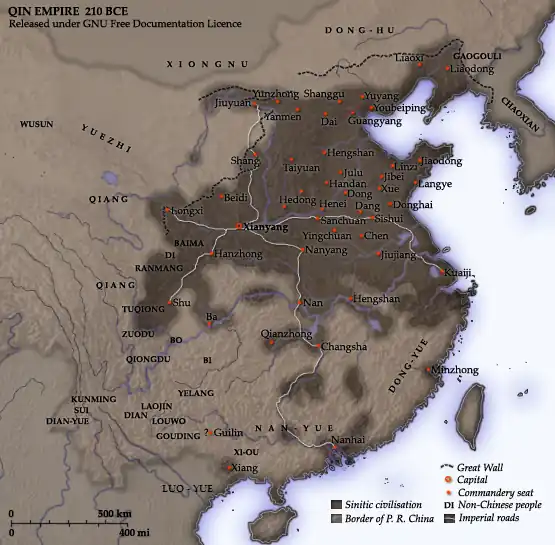
This map estimates the empire around 210 BCE, after subsequent expansion; it is not a map of the six states before conquest or an exact modern border. Map by Yeu Ninje (Itsmine), updated by Nguyen1310, resized and converted to WebP, CC BY-SA 3.0.
How did Qin govern the conquered lands?
Winning campaigns and governing territory were different tasks. Qin extended a system of commanderies and counties: larger districts were divided into smaller ones, with officials responsible to the state. Local arrangements varied, and Qin had used such districts before 221; the new empire extended them across conquered lands.
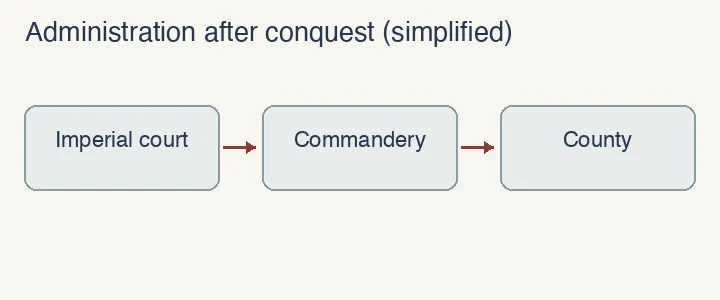
This diagram simplifies a more complex administration. The government also promoted common standards for weights and measures, coinage and writing. These policies helped officials administer a large territory and made some exchanges and records more consistent; they did not erase every local difference overnight.
Unification had costs. Conquest brought violence and displacement, and the imperial government demanded taxes, military service and labor. Qin's rule lasted only a short time after the First Emperor's death. The separate account of why the Qin dynasty fell follows that later crisis.
What do the sources tell us?
Sima Qian's Shiji, or Records of the Grand Historian, written about a century after unification, preserves a detailed narrative of Qin's rulers and campaigns. It is a major source, but its accounts were written after the events and should not be treated as a direct record of every conversation or motive. Archaeological finds and modern research add evidence about how Qin organized its wars and governed localities.
Qin ended the Warring States by eliminating rival kingdoms, then tried to make its conquest durable through imperial administration. The new order lasted beyond the dynasty in modified forms, though unification did not end conflict. For the ruler's wider career, see Qin Shi Huang.
FAQ
Which state did Qin conquer first and last?
Han fell in 230 BCE, and Qi surrendered in 221 BCE. Zhao and Yan had surviving regimes after their capitals fell.
Did Qin Shi Huang unify China by himself?
No. He ruled Qin during the final conquests, but inherited earlier gains and relied on generals, officials and soldiers.
Did the Zhou dynasty end in 221 BCE?
The Zhou royal house ended earlier, in 256 BCE. Qin's conquest of Qi in 221 BCE ended the Warring States period.