Questions
Which Emperor Built the Great Wall of China?
Qin Shi Huang, China's first emperor, is the ruler most closely associated with the early Great Wall. After unifying China in 221 BCE, he ordered sections of earlier northern fortifications joined and extended as a defensive system.
He did not build the entire Great Wall. Earlier states had built walls before his reign, and later dynasties built and rebuilt other sections. Many of the well-known brick and stone sections visible today date from the Ming dynasty, more than 1,500 years after Qin Shi Huang.
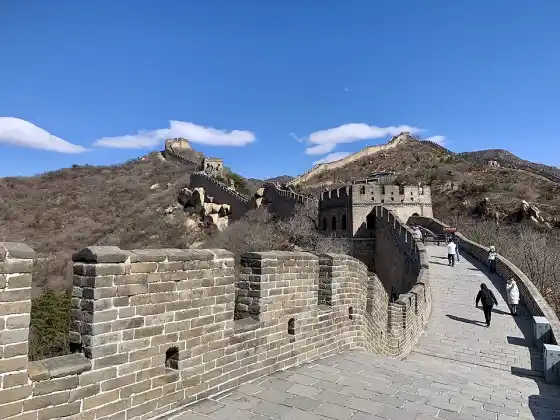
Badaling today: this section dates from the Ming dynasty and was repaired in modern times. Photograph by Dudva, Wikimedia Commons, CC0.
What Did Qin Shi Huang Build?
Before unification, rival states had constructed defensive walls. Under Qin Shi Huang, the new empire drew on some existing northern fortifications and built additional works to strengthen its frontier. UNESCO's Great Wall description places this effort around 220 BCE.
The work was part of a northern defense against groups beyond the frontier. It was not a single project that produced every wall now called the Great Wall, nor should all earlier state walls be imagined as one continuous Qin structure.
Who Actually Built the Wall?
The emperor ordered the work; laborers carried it out. The Shiji (Records of the Grand Historian) associates General Meng Tian and his army with the northern campaign and wall building. Its biography of Meng Tian records both, though its troop figure should not be treated as a precise count of wall builders. The exact number who died is unknown.
The distinction matters: naming an emperor identifies the ruler under whom a project was ordered, not the people who moved earth, carried materials, and built the defenses.
Which Dynasty Built the Wall Seen Today?
The Ming dynasty, which ruled from 1368 to 1644, built and rebuilt extensive northern defenses. Its walls include many of the brick and stone sections familiar from photographs and visits near Beijing.
For example, UNESCO's Great Wall periodic report identifies Badaling as a Ming section and notes later repairs and reconstruction. A visit to Badaling therefore does not show a wall built in Qin Shi Huang's lifetime.
The history between Qin and Ming also matters: later dynasties, including the Han, worked on frontier defenses. The Great Wall is a collection of structures built and altered over a long period, rather than one wall completed by one emperor.
Why Is Qin Shi Huang Often Given the Credit?
Qin Shi Huang was the first ruler to unite the former rival states under an empire. His government connected and extended northern defenses on an imperial scale, making his reign an important chapter in the wall's history.
That association can obscure both the earlier state walls and later construction. The Qin dynasty overview explains the empire that undertook this early phase.
Sources
- UNESCO World Heritage Centre: The Great Wall, on Qin's connection of earlier fortifications and later construction.
- UNESCO periodic report on the Great Wall, on the Ming date and modern repair of Badaling.
Frequently Asked Questions
Did Qin Shi Huang build the whole Great Wall?
No. He ordered earlier northern fortifications joined and extended; other walls were built before and after his reign.
Were any walls built before Qin Shi Huang?
Yes. Rival states built defensive walls before Qin unified China in 221 BCE.
Is the Great Wall near Beijing from the Qin dynasty?
Many familiar sections, including Badaling, date from the Ming dynasty, with later repairs and reconstruction.
Who physically built Qin's walls?
The Shiji associates General Meng Tian and his army with the northern campaign and wall building; Qin Shi Huang ordered the work.