Questions
What Did the Tang Dynasty Trade? Goods and Routes
Tang China (618–907) exchanged silk textiles and ceramics with buyers beyond its borders. Traders also brought goods such as spices, glass and metalwork into China. These exchanges moved through networks across Central Asia and by sea through Southeast Asia and the Indian Ocean.
Trade was not a single exchange between two empires. Goods passed through many hands, and the routes and goods available changed over the three centuries of Tang rule.
Silk and Textiles
Silk was a valued Chinese product, used within China as well as exchanged across borders. Its light weight made fine cloth suited to long-distance transport. Textiles also moved in other directions: imported fabrics and designs influenced Tang craftspeople.
Not every transfer was a private sale. Silk could also change hands through diplomatic gifts and payments. A surviving object alone does not necessarily reveal which kind of transaction brought it to a particular place.
Ceramics and a Shipwreck
Chinese kilns produced ceramics for many uses. By the ninth century, Chinese wares were travelling by sea in large quantities. A shipwreck found near Belitung Island in present-day Indonesia contained many Chinese ceramics, including thousands of bowls of a type made at Changsha kilns.
The wreck is evidence of a particular cargo and voyage, not a complete record of Tang exports or proof that every vessel reached its intended buyer. A bowl in the Metropolitan Museum of Art resembles objects recovered from the wreck.
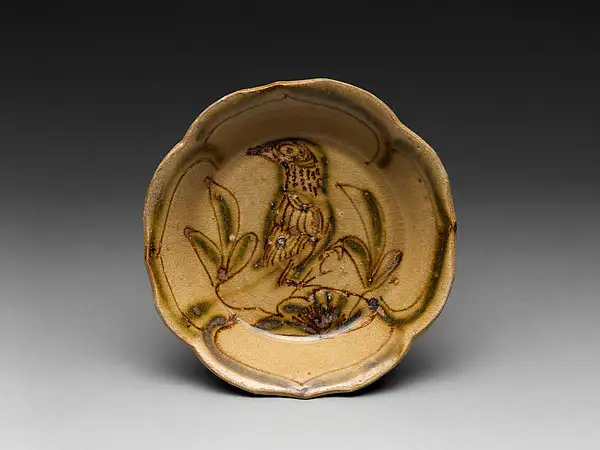
This Tang bowl resembles a type found in the Belitung wreck; it is not itself presented as an object from that wreck. The Metropolitan Museum of Art, public domain.
What Came Into China?
Imports included spices, aromatics, glassware and metalwork. Some reached China from or through South and West Asia; goods could be resold along the way, so their last port of departure was not necessarily where they were made.
Objects and styles travelled together. Metal vessels and textiles from other regions helped inspire Chinese makers, although an imported style on a Chinese object does not by itself prove that the object was imported.
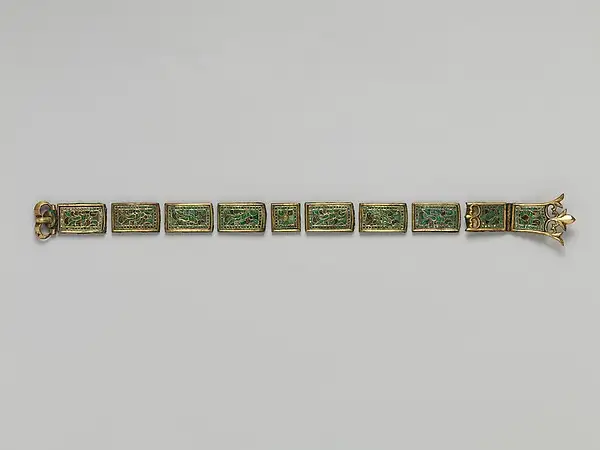
These Tang glass fittings illustrate glass used in China; glass was both locally made and imported. The Metropolitan Museum of Art, public domain.
Who Traded, and Along Which Routes?
Overland routes connected the Tang capital Chang'an, near modern Xi'an, with oasis towns in Central Asia and routes farther west. Merchants operated in networks; few needed to travel the whole distance. Diplomatic missions and religious travellers also moved along these routes, though their activities were not all commercial trade.
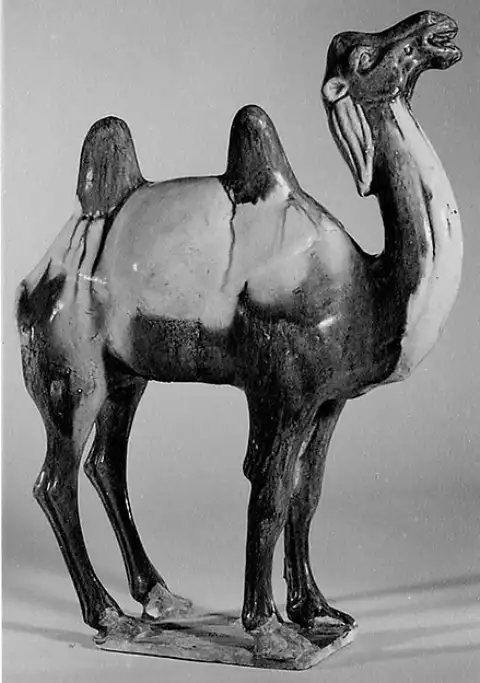
This ceramic tomb figure depicts a camel, an animal used to carry loads overland; it is not a record of a specific caravan. The Metropolitan Museum of Art, public domain.
Sea routes connected ports such as Guangzhou with Southeast Asia, India and the Persian Gulf. Ships depended on seasonal monsoon winds. The relative importance and safety of particular routes changed over time; neither land nor sea exchange was constant throughout the dynasty.
These connections carried people and ideas as well as merchandise. For another aspect of long-distance movement, see how Buddhism spread to China and how the Han dynasty used the Silk Road, which covers an earlier period.
What Can the Evidence Tell Us?
Museum objects, excavated cargoes and written records reveal particular goods and connections. They rarely give a complete balance sheet of imports and exports, and valuable objects survive more readily in some settings than everyday goods. The Belitung cargo is especially useful evidence for maritime ceramics, but it cannot describe all Tang trade.
Tang followed the Sui dynasty in 618. For the earlier transition into Sui rule, see what dynasty came before the Sui dynasty.
Sources
- Smithsonian National Museum of Asian Art: Tang dynasty — routes, travellers and exchanged materials.
- Metropolitan Museum of Art: Internationalism in the Tang dynasty — overland and maritime connections and artistic exchange.
- Smithsonian, Chinese Ceramics in the Late Tang Dynasty — the Belitung cargo and limits of evidence for exchange.
- Metropolitan Museum of Art: Bowl with bird — a Tang ceramic and related shipwreck finds.
Frequently Asked Questions
Did the Tang dynasty trade only silk?
No. Textiles and ceramics were among goods exchanged, while imports included spices, glass and metalwork.
Did Tang China trade by sea?
Yes. Maritime networks connected Chinese ports with Southeast Asia, India and the Persian Gulf.
Who carried Tang trade goods?
Merchants and sailors worked through connected regional networks; goods often passed through several hands.