Questions
What Dynasty Is China Named After? The Qin Theory
The dynasty most often associated with the English name China is the Qin dynasty (221–206 BCE). One influential theory connects the name to Qin, but its ultimate origin is disputed. The question does not have a proven one-dynasty answer.
The distinction matters: Qin was already a state before it became a dynasty. If the name came from Qin, it could have traveled abroad before the empire was founded; it need not have been coined during the dynasty itself.
Why do people connect China with Qin?
Qin was a powerful state in the western part of the ancient Chinese world. In 221 BCE its ruler, Qin Shi Huang, unified rival states and established the first imperial dynasty. A name used for Qin might, in theory, have become a name used by outsiders for a much larger region.
The historical context makes the theory possible, but it does not by itself prove that the word traveled that way. The sound of modern Mandarin Qin or English China alone cannot settle a question about ancient pronunciation and transmission.
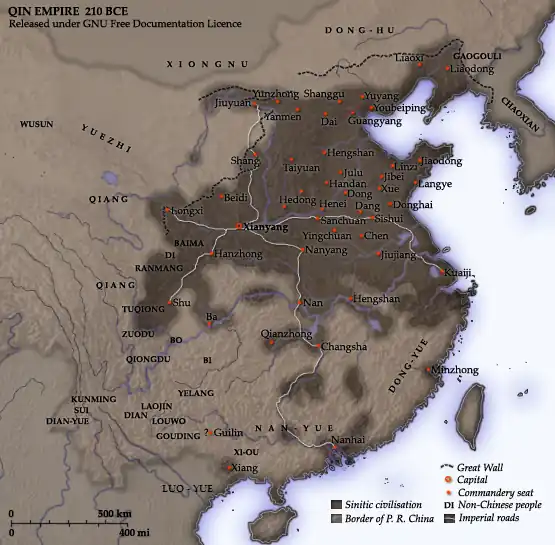
The Qin empire around 210 BCE. The map gives context for the Qin theory; it is not evidence that the name China came from Qin. Adapted from Yeu Ninje and Nguyen1310's map, CC BY-SA 3.0.
What evidence connects the names?
Names resembling China circulated in several languages. The Sanskrit term Cīna appears in Indian texts, while related-looking names occur in other Asian traditions. The English form is much later. Historian Samuel N. C. Lieu's study of names for China discusses these forms and argues for a connection with Qin.
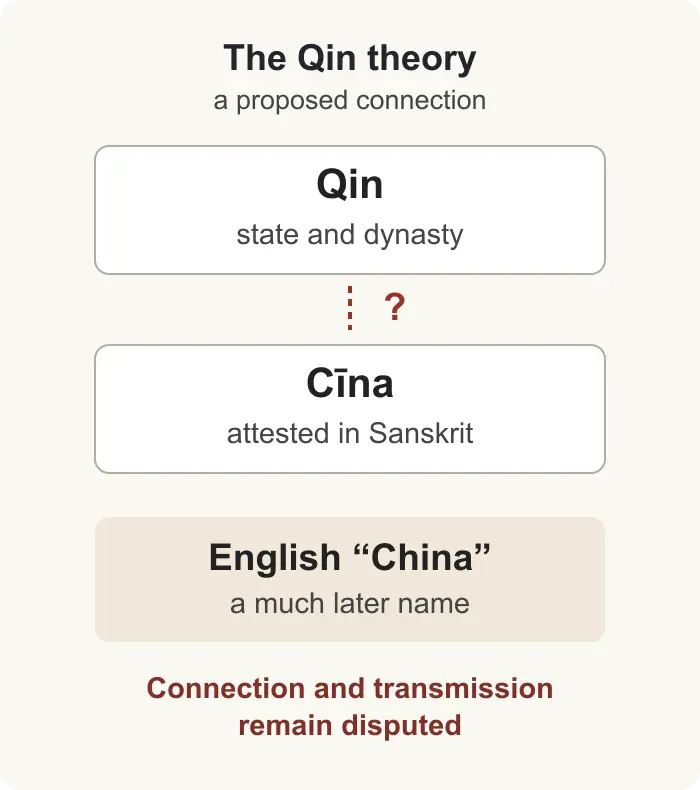
But finding similar names is not the same as documenting every step between them. Scholars must consider how words were pronounced at different times, when a particular passage was written, and how a name could have traveled between communities. The precise path from an early Asian name to the English word is not established at every link.
Why is the Qin theory disputed?
One difficulty concerns early Indian texts that contain Cīna. Their stories and surviving texts developed over long periods, so the age of a work as a whole does not automatically date each occurrence of the word. A reference said to be early needs its own dating evidence.
Even if a particular use predates the Qin dynasty, that would not automatically rule out Qin: the Qin state existed before 221 BCE. It would, however, challenge a claim that the term could only have spread after Qin founded its empire.
Researchers also disagree about pronunciation and alternative sources. For example, historian Geoff Wade proposed a connection to Yelang, a polity in southwest China, rather than Qin. His study is an alternative argument, not a demonstrated replacement for the Qin theory. Lieu defends Qin; these contrasting studies show why certainty would be misleading.
Is “China” a translation of Zhongguo?
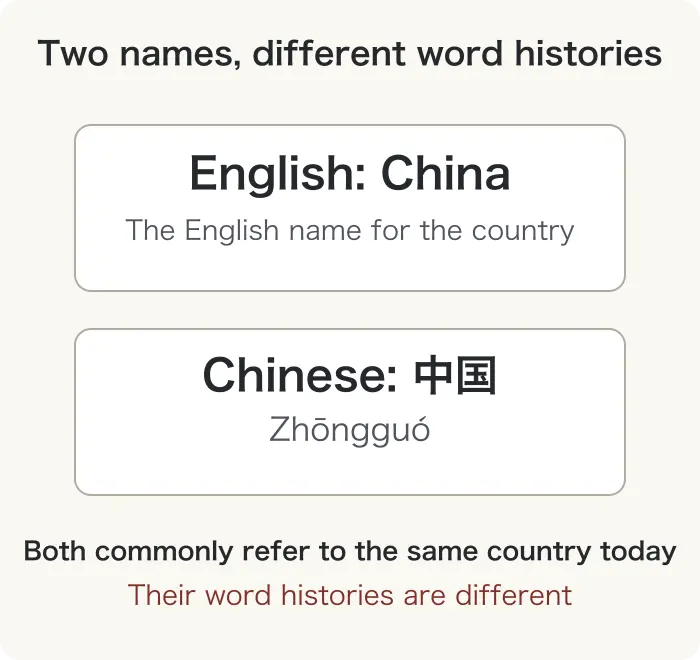
No. Zhōngguó (中国) is the modern Chinese name commonly translated as “China.” The English word is not a literal translation of its two characters. Zhongguo has a long history of changing uses, so its older meanings should not automatically be treated as identical to the modern country name. For the history of its usage, see historian Luke S. K. Kwong's study of Zhongguo.
What should readers conclude?
Qin is a prominent answer to the dynasty question, and the earlier Qin state is part of the same hypothesis. The surviving evidence and scholarly disagreement do not justify stating that the English name was definitely derived from either one. For the dynasty’s place in the wider timeline, see what came after the Qin dynasty.
Sources and further reading
- Samuel N. C. Lieu, “From Qin (Ch’in) to Cathay”, The Medieval History Journal (2024): argues for Qin and reviews forms of the name across languages.
- Geoff Wade, “The Polity of Yelang and the Origins of the Name ‘China’”, Sino-Platonic Papers 188 (2009), pp. 1–2 and 9–17: surveys earlier theories and proposes Yelang.
- Luke S. K. Kwong, “What's in a Name: Zhongguo Reconsidered”, The Historical Journal (2015): examines the changing uses of Zhongguo.
FAQ
Is China definitely named after the Qin dynasty?
No. A connection with Qin is influential, but the ultimate origin and transmission of the name remain disputed.
Could the name refer to the Qin state before the dynasty?
Possibly. Qin existed as a state before it founded an empire in 221 BCE, so the hypothesis is not limited to the years of the dynasty.
Does China literally mean Middle Kingdom?
No. Middle Kingdom is a common translation of the Chinese name Zhongguo; it is not the literal meaning of the English word China.