Questions
Why Did China Build the Great Wall? Three Reasons
China's rulers built the Great Wall chiefly to defend northern frontier regions against raids and invasions. Walls, towers, passes, and garrisons worked together to help armies watch the frontier and respond to threats.
Their aims varied across time and place:
- Make raids harder and protect settlements.
- Give frontier troops warning and defensible positions.
- Strengthen control of important routes and passes.
The Great Wall was not one wall built in a single reign. Earlier states and later dynasties constructed different fortifications over many centuries, often in different locations.
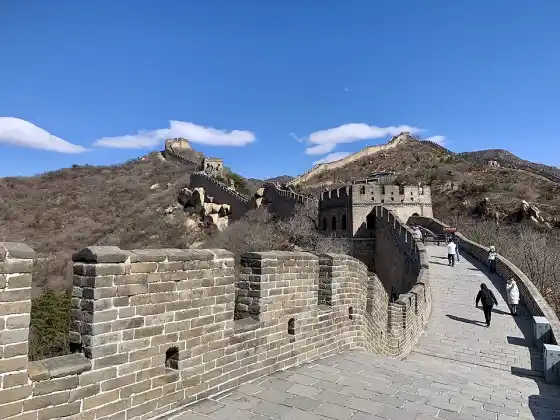
Badaling is a Ming-era section that has been repaired in modern times. Its towers and mountain position show how a wall could support frontier defense.
Three reasons for building frontier walls
1. Make raids harder
Northern frontier communities could be exposed to attacks by mobile forces from the steppe, the broad grasslands north of settled farming regions. Walls and guarded passes could slow movement, make it harder to carry away people and livestock, and give defenders time to react. They could not make a frontier completely safe.
Threats changed over time. The Qin empire faced the Xiongnu, a powerful confederation to its north; Ming rulers later faced Mongol forces. Neither the people beyond the walls nor their relationships with Chinese states were always the same.
2. Help troops watch and respond
A wall was only one part of a military system. Watchtowers and beacon stations helped transmit warnings, including by smoke or fire, while forts and garrisons housed soldiers who could respond.
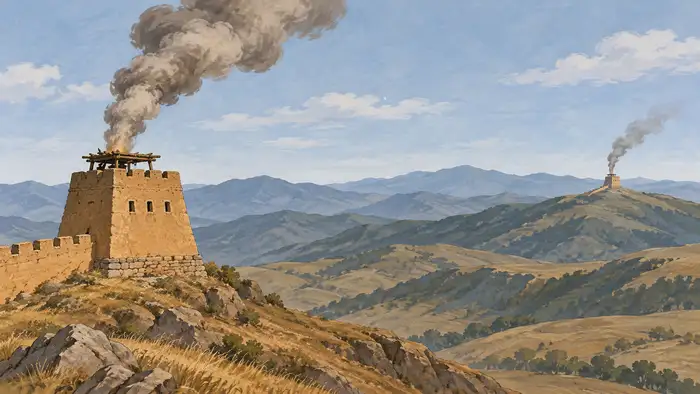
A barrier had to be manned, supplied, and maintained to be useful.
This helps explain why rulers invested in walls even though a determined army could find a way around or through them: the goal was to improve the odds for defenders, not to replace an army. UNESCO's description of the Great Wall identifies towers, fortresses, and passes as parts of the wider complex.
3. Control important routes
Fortified passes gave troops positions from which to monitor and defend important crossings. Under the Ming, the government also regulated passage through frontier gates, as historian Jiang Yonglin explains in a study of the Great Ming Code. The roles of individual passes varied.
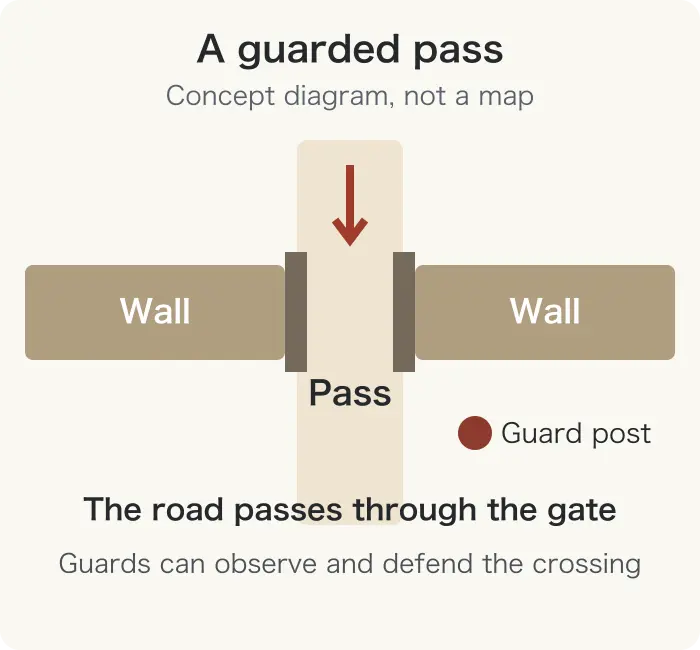
In the northwest, defenses stood along corridors connecting China with Central Asia. The UNESCO Silk Roads listing includes wall sections, passes, and beacon towers among the remains of this route network. Their location along these routes alone does not establish why a particular wall was built.
That does not mean every section was built for trade. Military security was the central concern, and the role of particular passes and routes varied by period.
How rulers faced changing threats
Around 220 BCE, Qin Shi Huang, the first emperor of a unified China, ordered earlier northern fortifications joined and extended. His government sought to strengthen the new empire's northern defense; the Qin dynasty did not create every section now called the Great Wall.
Many centuries later, the Ming dynasty built and reinforced major defenses against northern threats. Its system included military districts, fortresses, and passes, as described in the ICOMOS evaluation of the Great Wall. The familiar masonry at Badaling belongs to this later phase, not Qin's reign.
How the purpose changed over time
- Before Qin: Rival states built defensive walls, including fortifications on northern frontiers.
- Qin, around 220 BCE: The unified empire connected and extended some northern defenses.
- Han dynasty: Frontier defenses reached into the northwest, where walls and beacon towers formed part of a network along routes toward Central Asia.
- Ming dynasty, 1368–1644: The government built and strengthened extensive northern defenses; many familiar surviving sections date from this period.
These are selected stages, not a continuous construction schedule. Governments also relied on campaigns, diplomacy, and other policies; frontier walls were one choice among several.
Did the Wall keep invaders out?
Not always. A wall could delay attackers and direct them toward guarded points, but its effectiveness depended on soldiers, supplies, leadership, and the wider political situation. In 1644, the rebel leader Li Zicheng captured the Ming capital, Beijing. Wu Sangui, the Ming general at Shanhai Pass, sought Qing help against Li; Qing forces then entered through the pass. The alliance shows why a fortification could not determine the outcome on its own.
Building and maintaining defenses also demanded labor and resources. The Wall's history includes the burdens placed on workers as well as the military aims of rulers.
What to remember
Chinese states built frontier walls primarily for defense, but the specific threats and uses changed over centuries. Thinking of the Great Wall as a network of defenses makes its purpose clearer than imagining a single, unbeatable barrier. For the people behind its best-known early building campaign, see which emperor built the Great Wall.
Sources and further reading
- UNESCO World Heritage Centre: The Great Wall — Qin-era fortifications and the components of the wall system.
- ICOMOS, evaluation of the Great Wall — historical development and Ming military organization.
- UNESCO: Silk Roads, Chang'an–Tianshan Corridor — frontier installations and routes through the northwest.
- Jiang Yonglin, The Great Ming Code and the Human Realm — regulations and fortified frontier passes under the Ming.
- Indiana University: Ming–Qing historical sources, section I.B — Wu Sangui invited the Qing through Shanhai Pass against Li Zicheng.
FAQ
Was the Great Wall built only to stop the Mongols?
No. Some northern walls predate the Mongols by many centuries. Ming defenses later faced Mongol forces, but threats and purposes varied over time.
Did the Great Wall completely seal China off?
No. Passes allowed controlled movement, and the wall system could be crossed or bypassed. Trade, diplomacy, and conflict continued across the frontier.
Was the whole Great Wall built at the same time?
No. Different states and dynasties built, connected, and rebuilt fortifications over many centuries.