Questions
Who Unified the Three Kingdoms of China?
Sima Yan, Emperor Wu of Jin, completed the reunification of the Three Kingdoms in 280 CE. His Western Jin dynasty conquered the last rival state, Wu, bringing the principal territories of Wei, Shu Han, and Wu under one imperial government.
The process took place in stages. Wei conquered Shu in 263, before Sima Yan founded Jin in 265. Wu survived until 280, so the founding of Jin and the completion of reunification were different events.
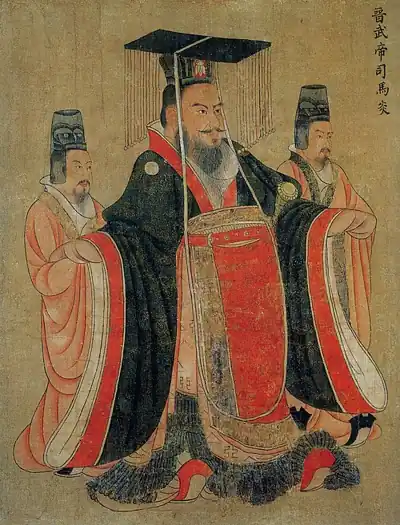
This is a later painted image, not a contemporary likeness. Wikimedia Commons, public domain.
How Did Jin Bring the Three Kingdoms Together?
The Three Kingdoms were Wei in the north, Shu Han in the southwest, and Wu in the southeast. By the middle of the third century, the Sima family held effective power at the Wei court, although the Cao family still occupied the throne.
Wei conquered Shu in 263
In 263 Wei armies attacked Shu. Shu's ruler Liu Shan surrendered, and Shu's territory passed to Wei. Sima Zhao, Sima Yan's father, controlled the Wei government at the time. This was a Wei conquest, not a conquest by the Jin dynasty, which had not yet been founded.
Sima Yan replaced Wei in 265
After Sima Zhao died in 265, his son Sima Yan took over his position. Later that year, the Wei emperor Cao Huan abdicated in his favor. Sima Yan founded Jin, known to historians as Western Jin, and inherited Wei's lands, including former Shu territory. Some works date the founding to 266 because of the conversion between calendars.
This symbolic illustration is not a reconstruction of the Wei court or the conquest of Shu.
The story of Sima Yi, Sima Yan's grandfather, explains how the family rose to power in Wei. Sima Yi died long before the conquest of Wu; he did not personally reunify the Three Kingdoms.
Jin conquered Wu in 280
Wu still ruled south of the Yangtze. Jin launched a coordinated campaign by land and river, including a fleet that advanced downstream through the Yangtze gorges. In 280 Wu's ruler Sun Hao surrendered, and Jin took its capital, Jianye, near modern Nanjing.
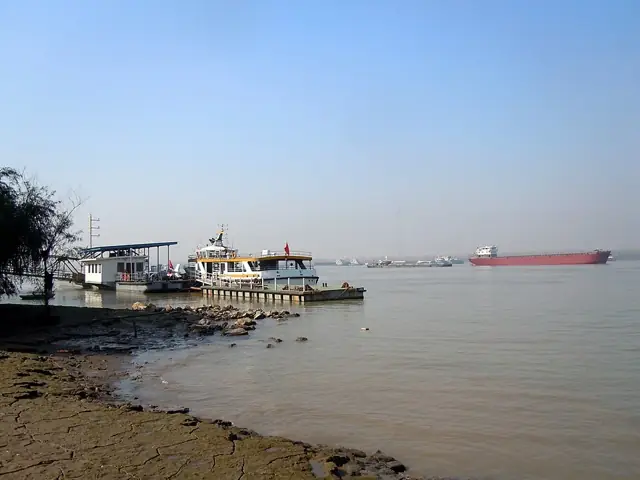
The modern Yangtze near Nanjing helps locate the river near ancient Jianye; it does not show the campaign itself. Photograph by Sinopitt, via Wikimedia Commons, resized and converted to WebP, CC BY-SA 3.0.
The surrender ended the last of the three rival states. For the sequence as a story, read Three Kingdoms Return to Jin.
Was the Unity Permanent?
No. The reunification of 280 brought the main territories of the three states under one dynasty, but it did not prevent later conflict. Struggles within the Jin ruling house and wars in the early fourth century were followed by the loss of Western Jin's northern capital. The Wei-Jin and Southern and Northern Dynasties overview follows the period after this reunification.
Sources
- Rafe de Crespigny, “The Three Kingdoms and Western Jin,” Australian National University, pp. 145–146 — Jin's campaign against Wu and its river and land forces.
- Damien Chaussende, “Western Jin,” The Cambridge History of China, pp. 79–95 — Sima Yan, the Sima family and the 265/266 dating convention.
- The Metropolitan Museum of Art, chronology of the Six Dynasties — dates for Wei, Shu, Wu and Western Jin.
Frequently Asked Questions
Did Sima Yi unify the Three Kingdoms?
No. His grandson Sima Yan was the Jin emperor when Wu surrendered in 280; Sima Yi had died decades earlier.
Which kingdom fell last?
Wu fell last, surrendering to Western Jin in 280. Shu had fallen to Wei in 263, and Jin replaced Wei in 265.
Did Wei or Jin conquer Shu?
Wei conquered Shu in 263. Jin inherited the former Shu territory when Sima Yan replaced Wei in 265.