Questions
What Did the Han Dynasty Invent? Paper and Other Innovations
The Han dynasty is associated with early paper, improvements to papermaking, and Zhang Heng's earthquake-detecting device. Han craftsmen and officials also developed tools such as water-powered bellows for ironworking.
These achievements were not all inventions made from scratch. Early paper existed before the famous official Cai Lun, while ironworking and astronomical observation had longer histories. The Han dynasty lasted from 206 BCE to 220 CE, giving such technologies time to develop across generations.
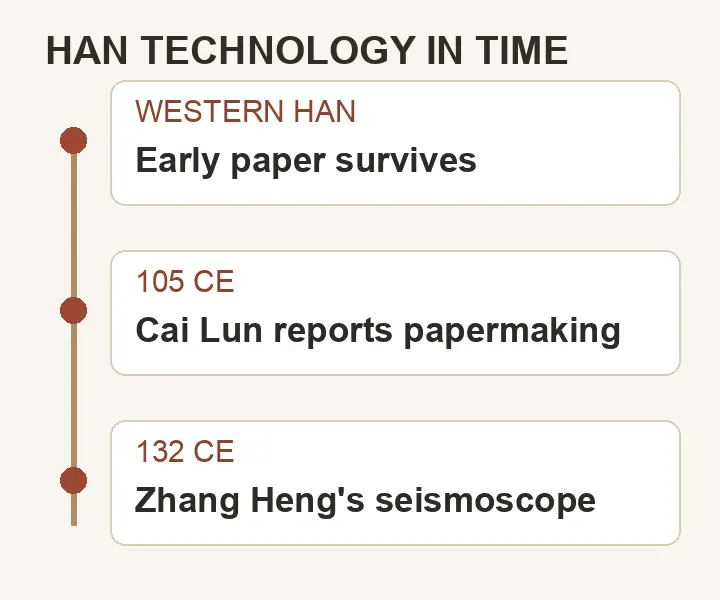
This timeline brings together surviving early paper and two events described in later historical records. The sections below explain what each kind of evidence can tell us.
Paper: an early invention that improved over time
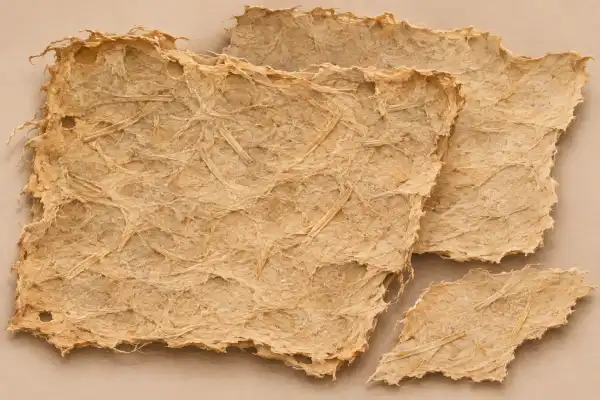
An illustration of early fiber paper, not a photograph of an excavated specimen.
Paper is the Han achievement with the most familiar legacy. Archaeologists have found early paper dating to the Western Han, before Cai Lun lived. Its quality varied, and some early finds are disputed: a study summarized by the Smithsonian's Museum Conservation Institute questioned whether one famous find was paper while identifying other Western Han samples as early paper.
Cai Lun was an Eastern Han court official. The later Book of the Later Han, chapter 78, credits him with making paper from materials including bark, hemp, rags, and old fishing nets, and reporting the method to the court in 105 CE. The text is in Chinese; the Metropolitan Museum of Art also discusses Cai Lun and the earlier evidence in English.
Cai Lun is therefore better understood as an important figure in papermaking's development than as the sole inventor of the first paper. Paper did not immediately replace bamboo, wood, or silk as a writing material; the Met notes that it became widely used in China by the third century CE.
How did Zhang Heng's detector work?
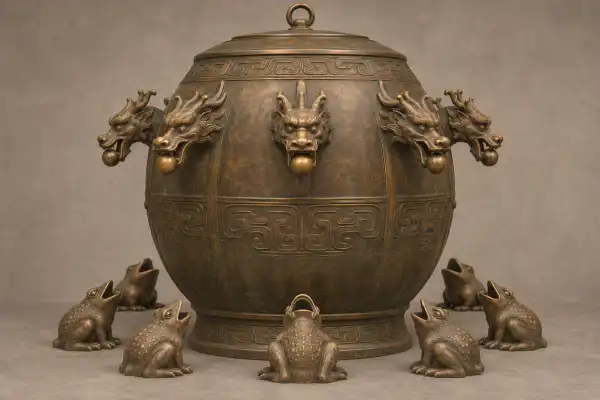
An illustration of the device's exterior; the original is lost, and its exact appearance is uncertain.
In 132 CE, the scholar Zhang Heng made a device known today as a seismoscope: an instrument intended to indicate the direction of an earthquake. Unlike a modern seismograph, it is not described as recording seismic waves or measuring magnitude.
The Book of the Later Han, chapter 59 describes eight dragon heads around a vessel. According to the account, a ball would drop from one dragon's mouth into a toad below, indicating a direction. It also records a signal felt by no one at the capital, followed by news of an earthquake to the west.
The original instrument has not survived. Its internal mechanism is uncertain, and a modern model should not be mistaken for the original. The Met's Han dynasty overview identifies the 132 CE instrument as an example of Han technology.
Water power and ironworking
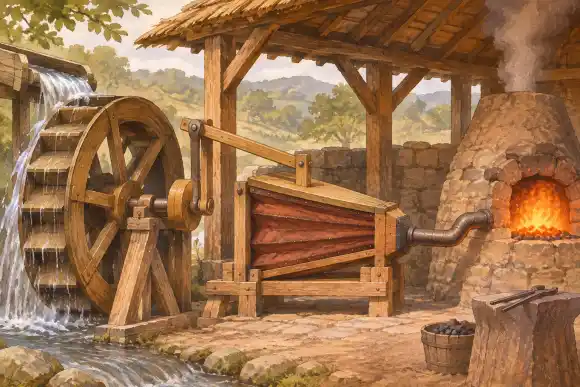
A conceptual illustration of water-powered bellows supplying air to a furnace, not an exact reconstruction of a Han machine.
Ironworking was older than the Han dynasty, but Han workers developed ways to power it. Historical accounts associate the official Du Shi with using water power to operate bellows, devices that force air into a furnace. A stronger, sustained air supply helped support the high temperatures needed for iron production.
The historian of Chinese metallurgy Donald B. Wagner discusses the evidence for Han ironworking and water-powered bellows. The written account does not preserve every mechanical detail, so it is safer to describe the use of water power than to claim an exact reconstruction.
What else developed during the Han?
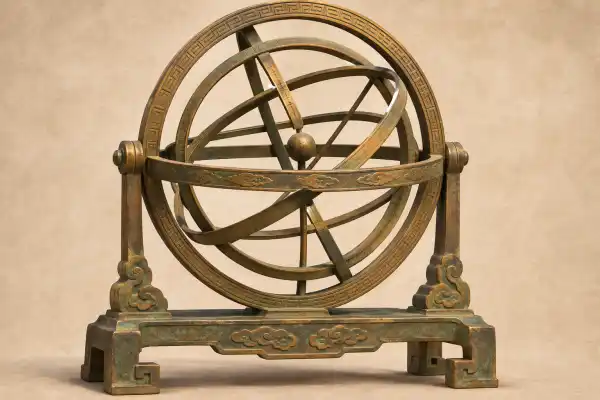
An illustration of an armillary sphere, not an exact reconstruction of a surviving Han instrument.
An armillary sphere uses rings to represent reference circles in the sky, such as the celestial equator, helping people describe the positions of celestial bodies. Designs and uses varied; the History of Science Museum at Oxford explains the basic ring model.
Han astronomers used and developed instruments for observing the sky, along with water clocks and sundials for measuring time. Court officials needed calendars to organize official dates and seasonal activities. These were significant developments, but observation and timekeeping did not begin in the Han period.
Did the Han invent all four great inventions?
No. Of the inventions commonly grouped as China's four great inventions, paper has the clearest connection to the Han. Printing, gunpowder, and the compass each developed through multiple stages, with important advances after the Han dynasty. They should not all be assigned to one reign or dynasty.
To see what happened after this long period of innovation, read why the Han dynasty fell.
FAQ
Did Cai Lun invent paper?
Early paper existed before Cai Lun. A later historical account credits him with a papermaking method reported to the court in 105 CE, making him an important figure in its development rather than the sole inventor of paper.
Was Zhang Heng's device a modern seismograph?
No. It was intended to indicate the direction of an earthquake, not to record seismic waves or measure magnitude. The original has not survived, and its mechanism is uncertain.
Did the Han dynasty invent gunpowder and printing?
No single Han invention accounts for either technology. Both developed over multiple stages, including important advances after the Han period.