Topics
Terracotta Army: When It Was Built and What It Reveals
The Terracotta Army is a collection of life-size clay soldiers and horses buried in pits near the tomb of Qin Shi Huang, China's first emperor. Made during the third century BCE, the figures were part of a much larger burial complex. Local farmers found the army pits in 1974 while digging a well.
The figures were made of fired clay; some still preserve traces of their original paint. Their ranks, weapons and manufacture help archaeologists study Qin military imagery and the organization of a vast burial project. They do not reveal the emperor's private thoughts with certainty.
Key Facts
- Period
- Third century BCE, during the Qin state and empire
- Location
- Lintong, near Xi'an, Shaanxi
- Discovery
- 1974, during well digging
- Material
- Fired clay figures; bronze and other materials for equipment
- Associated ruler
- Qin Shi Huang, who died in 210 BCE
When Was the Terracotta Army Built?
The army was made in the third century BCE for Qin Shi Huang's burial complex. The Qin dynasty unified rival states in 221 BCE, but work on the ruler's burial complex began earlier, while he was still king of Qin.
UNESCO's account of the mausoleum dates the start of the tomb project to 246 BCE, conventionally the first numbered year of the future emperor's reign as king of Qin. Some chronologies date his accession to 247 BCE. The tomb project's date does not establish when workers began making the first terracotta soldier. Qin Shi Huang died in 210 BCE, and the exact dates for producing and placing individual figures are not known from that starting date alone.
Sima Qian's later history, the Shiji, or Records of the Grand Historian, describes the building of the ruler's tomb. It is a written account composed after the Qin period, not a direct excavation record of the army pits. Archaeologists use material evidence alongside such texts and distinguish the history of the entire complex from the dating of particular objects.
Where Was the Terracotta Army Found?
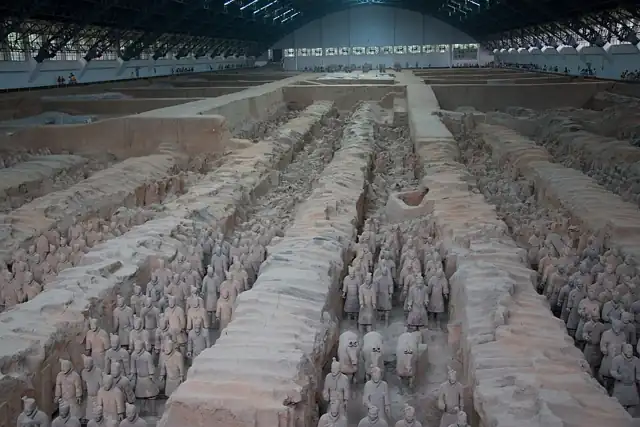
Pit 1 today: the surviving soldiers stand in corridors within the excavated earth. Maros Mraz, resized and converted to WebP, CC BY-SA 2.5; license.
The pits are in Lintong, near Xi'an in Shaanxi province, roughly 1.5 kilometers east of the emperor's burial mound. In 1974 local farmers digging a well came across traces of the buried figures; archaeological excavation followed. The Metropolitan Museum of Art describes both the discovery and the pits' position.
The army pits belong to the wider mausoleum complex, but they are not inside the emperor's burial chamber. The visible soldiers are only one part of a much larger site that also contains other burial pits, structures and graves.
What Are the Warriors Made Of?
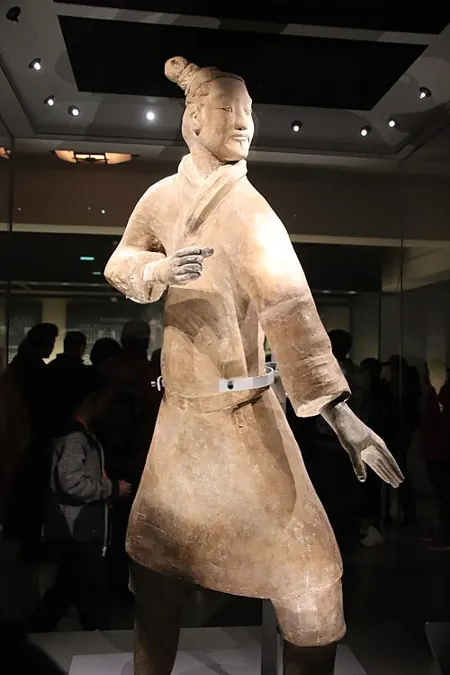
A standing archer from Pit 2. The photograph shows a surviving figure rather than a reconstruction of its original colors. Gary Lee Todd, resized and converted to WebP, CC0; dedication.
The soldiers and horses are terracotta: clay shaped and hardened by firing. Microscopic analysis of fragments from twelve warriors found evidence consistent with carefully prepared, sand-containing clay and firing. The authors suggest that firing probably took place in a permanent structure such as a kiln, while noting that the process remains a subject of research.
Researchers have proposed different ways to make the figures. Some accounts describe separately formed parts joined together; an experimental reconstruction explored making much of the body as one piece. These are interpretations of a complex craft, so one proposed sequence should not be treated as proven for every statue.
Many figures were originally painted, although much of their color has been lost. The clay figures were accompanied by equipment made from other materials, including bronze weapons; the army was not made entirely of clay.
Why Was the Terracotta Army Buried?
The usual interpretation is that the figures formed an army for the emperor in the world after death. Their position and military arrangement fit a broader burial complex that represented aspects of an imperial world. That is an interpretation of the objects and their setting, not a surviving statement of precisely what Qin Shi Huang believed.
Soldiers, horses, weapons and their arrangement also invite comparison with the real forces that helped Qin conquer its rivals. The burial army is a representation, however; it should not be treated as a complete inventory of the actual Qin army or proof that each face portrays an individual soldier. For the historical campaigns behind unification, see how Qin Shi Huang unified China.
What Does the Army Reveal About Qin Power and Labor?
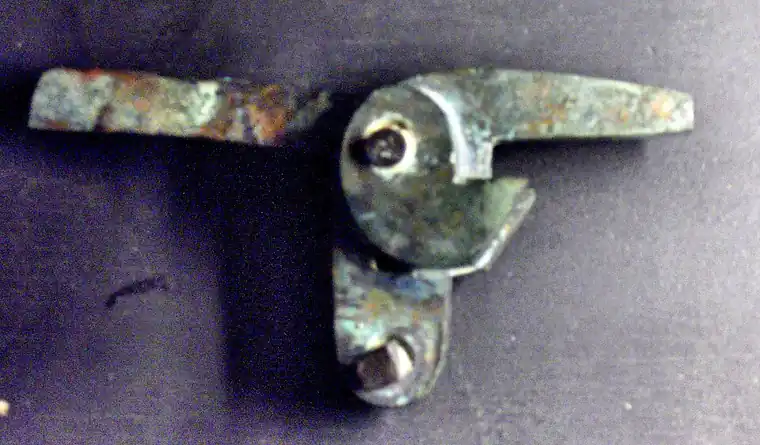
A bronze crossbow trigger identified as coming from Pit 2. JoJan, contrast adjusted by Ismoon, resized and converted to WebP, CC BY 3.0; license.
The scale of the pits shows that the project required materials, skilled makers, transport and coordination. Archaeologists can investigate that organization through the objects themselves, rather than relying only on later descriptions of the emperor's power.
For example, a study of bronze crossbow triggers from Pit 1 found evidence of production in batches. The authors suggest that the batches may then have been stored and distributed to equip groups of figures. This is evidence about the triggers studied; it does not prove that every figure or weapon followed one identical production line.
The project also depended on human labor. Later written accounts describe a large workforce at the mausoleum, but surviving figures alone cannot tell us the exact number of workers, every person's working conditions, or whether all were enslaved. These questions require written evidence and archaeological research together.
What Remains Uncertain?
Excavation, conservation and scientific analysis continue to change what can be learned from the complex. Different parts of the site have been investigated to different degrees. A missing object or a damaged figure is not, by itself, proof of exactly when or why it was damaged.
The army is especially useful because it gives historians physical evidence to compare with later accounts. Its weapons and figures show the skills and resources involved; its burial setting supports interpretations about rulership and death. Neither source can answer every question on its own.
FAQ
When was the Terracotta Army built?
The figures were made in the third century BCE for Qin Shi Huang's burial complex. The larger tomb project began in 246 BCE, but that date does not establish when individual figures were made.
What are the Terracotta Warriors made of?
The figures were made from clay and fired. Some retain traces of paint, and associated weapons included bronze objects.
Where was the Terracotta Army found?
The army pits were found in 1974 at Lintong, near Xi'an, about 1.5 kilometers east of Qin Shi Huang's burial mound.
What does the Terracotta Army tell us about Qin Shi Huang?
It shows the scale of his burial complex and the organization needed to furnish it. Its military arrangement is commonly interpreted as an army for the afterlife, though his precise beliefs cannot be recovered from the figures alone.
Sources
- Shiji, chapter 6: Qin Shi Huang's annals (Chinese), for the later written account of the mausoleum.
- UNESCO: Mausoleum of the First Qin Emperor, for the mausoleum's setting and the date of the larger tomb project.
- The Metropolitan Museum of Art: Making the Warrior, for discovery, location and differing accounts of manufacture.
- Quinn and colleagues: Building the Terracotta Army, for microscopic analysis of clay and firing.
- Li and colleagues: Crossbows and Imperial Craft Organisation, for evidence from bronze trigger mechanisms in Pit 1.
- Smithsonian National Museum of Asian Art: Qin Dynasty, for historical context and the afterlife interpretation.