Topics
The Silk Road: Origins, Routes, and Exchange
The Silk Road was a network of routes connecting communities across Asia and, through further exchanges, the Mediterranean world. Silk was one valuable commodity, but people also moved other goods, religious teachings, and artistic ideas.
The network developed over time. Older regional routes already existed before the Han dynasty. From the second century BCE, Han diplomacy and expansion, together with the work of Central Asian communities and merchants, helped connect these routes across greater distances. No single person or state created the whole network.
How Did the Silk Road Develop?
People exchanged goods across parts of Eurasia long before the Han. These earlier contacts did not form one continuous, unchanging highway. Over time, neighboring networks became linked more closely.
In the second century BCE, the Han court sought allies against the Xiongnu, a powerful confederation on its northern frontier. It sent the envoy Zhang Qian west to seek an alliance with the Yuezhi. He did not secure that alliance, but the information he brought back increased Han knowledge of regions farther west.
Han campaigns and diplomacy extended the dynasty's influence along the Hexi Corridor, a passage leading northwest toward Dunhuang and the oasis regions beyond. Connections with Central Asian states grew, but imperial power did not remain equally strong everywhere or at every time. Oasis communities, local rulers, and traders maintained their own relationships and played essential roles in moving goods and people.
By the first century CE, routes linking northern China and Central Asia formed part of wider long-distance exchanges. Their growth was a process involving many societies, rather than an event with a single founding date. For a closer look at the Han court's aims, see how the Han dynasty used the Silk Road.
Where Did the Routes Go?
One important overland corridor led from Chang'an, near modern Xi'an, through the Hexi Corridor toward Dunhuang. From there, routes crossed or skirted desert and mountain regions to reach Central Asian oases. Other connections led toward South Asia, West Asia, and the Mediterranean.
Travel depended on water, animals, local knowledge, and arrangements with communities along the way. Routes shifted with politics, safety, and environmental conditions. The UNESCO-listed Chang'an–Tianshan corridor represents one section of a much larger network, not the entire Silk Road.
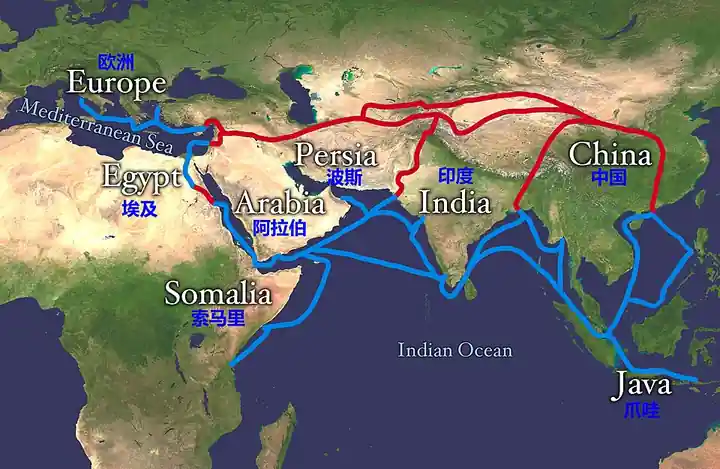
The red lines suggest overland routes and the blue lines maritime routes. This overview combines connections from different periods; it does not show roads that were all in use at the same time. Chang'an and Dunhuang are not labeled. Map by Wikiality123, Chinese-labeled version uploaded by Gabhksw; original, CC BY-SA 3.0, resized and converted to WebP.
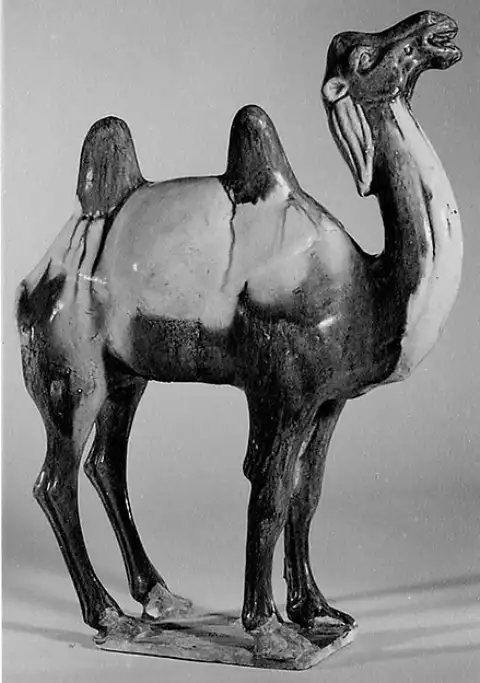
This eighth-century tomb figure depicts a camel, an animal used for overland transport. It does not document a particular caravan or the network's Han-period origins. The Metropolitan Museum of Art, public domain.
Who Moved Goods and What Did They Carry?
Goods often passed between merchants in different regions instead of traveling the whole distance with one person. Local guides, oasis towns, political authorities, and animals carrying loads all helped sustain movement. Later, Sogdian merchants from Central Asia became especially prominent in parts of the network.
Silk moved westward, while horses, glass, and other goods circulated through connected regions in different directions. Objects could also move as gifts, payments, or tribute; finding an object far from where it was made does not by itself prove how it changed hands.
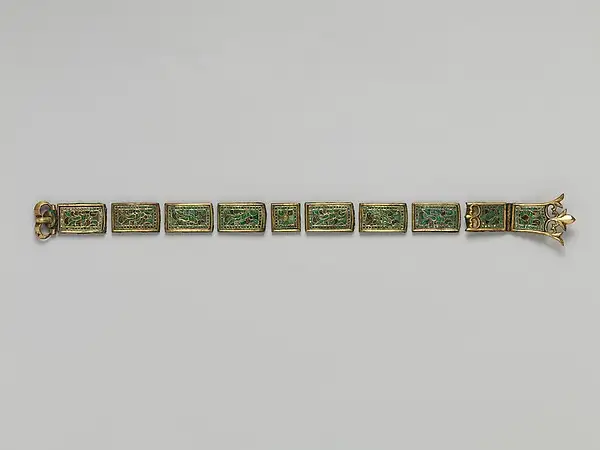
These Tang gilt-bronze belt fittings, inlaid with glass and pearls, show glass used in China. Glass could be made locally or imported, so this object alone does not establish a trade route. The Metropolitan Museum of Art, public domain.
Ideas and Religions Across the Routes
Merchants, monks, translators, and patrons helped connect religious communities as well as markets. Buddhism began in South Asia and spread through networks that included Central Asian oases. Evidence places Buddhist practice in China by the Eastern Han, but the exact first arrival and route remain uncertain. Read more about how Buddhism spread to China.
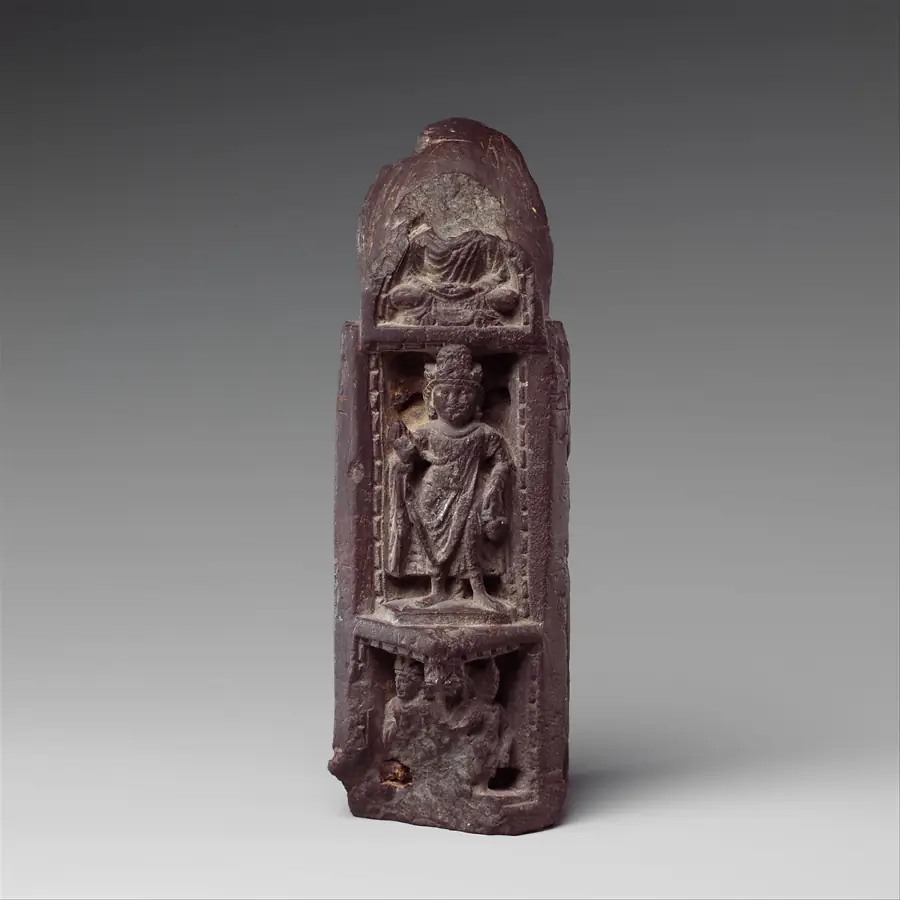
This section of a later shrine comes from Gandhara, a region connected to wider Asian networks. It illustrates Buddhist material culture; it is not evidence of the first journey to China. The Metropolitan Museum of Art, public domain.
Did the Silk Road Stay the Same?
The routes changed over centuries. During the Tang dynasty, Chang'an and Central Asian cities were part of active exchanges involving merchants, envoys, and religious travelers. Conflict and political change could disrupt individual routes, while maritime networks also connected China with other regions.
The name “Silk Road” is modern: it was coined in the nineteenth century. It is a useful label for a complex history, but it should not suggest that ancient travelers used one official road or that only silk moved along it.
Sources
- UNESCO: About the Silk Roads — Zhang Qian’s diplomatic mission and the modern name.
- UNESCO: Chang'an–Tianshan Corridor — geography, chronology, and evidence for a section of the wider network.
- UNESCO: Zarafshan–Karakum Corridor — Central Asian routes and Sogdian merchants.
- The Metropolitan Museum of Art: Buddhism along the Silk Road — religious and artistic exchange in a later period.
- UNESCO: Tales from silken times — the modern name and the longer history of exchange.
Frequently Asked Questions
Who created the Silk Road?
No single person created it. Existing regional routes became more closely connected through the actions of many communities, merchants, and states over time.
Did Zhang Qian invent the Silk Road?
No. His missions expanded Han knowledge of regions to the west, while the wider network depended on existing routes and many other participants.
Was the Silk Road one road?
No. It was a changing network of routes and communities across many regions.