Questions
Why Did Qin Shi Huang Abolish Feudalism?
Qin Shi Huang chose to govern the newly unified empire through commanderies and counties rather than divide it into hereditary kingdoms. According to a later account in the Shiji, he accepted the argument that powerful regional rulers could eventually fight one another and threaten peace.
Here, “feudalism” refers to the granting of territories to hereditary rulers, often called enfeoffment. It is a comparison with a Chinese political arrangement, not an exact match for medieval European feudalism. Qin had already used counties and commanderies before unification in 221 BCE; the decision was to extend direct administration across the empire instead of establishing new regional kings.
Three points explain the choice and its limits:
- The court faced a choice about how to govern distant territories after conquest.
- Li Si argued that hereditary rulers had contributed to conflict under the Zhou.
- Commanderies and counties gave the court an administrative framework for governing through officials.
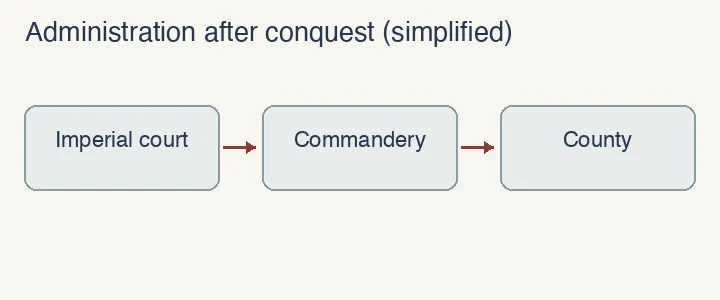
The diagram shows a simplified hierarchy. Actual local administration involved more offices and arrangements than these three levels.
What Was the Alternative to Hereditary Kingdoms?
The Zhou dynasty had granted territories and authority to relatives and allies who became regional rulers. Their relationships with the royal house changed over centuries. By the Warring States period, powerful kingdoms competed for territory and authority.
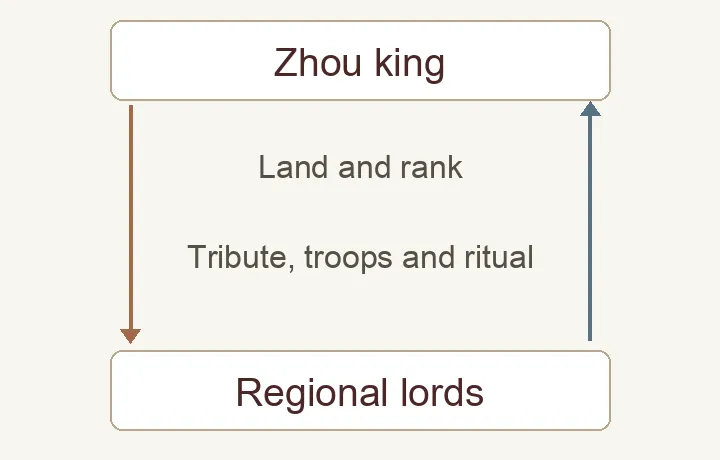
This diagram simplifies relationships that changed over time and differed among regions. Some grants included people as well as land; they did not describe the experiences of everyone living there.
Qin itself had developed a different way to administer territory before it conquered its rivals. A commandery was a large administrative district; counties were smaller districts within it. Officials served the state, rather than ruling an independent kingdom by hereditary right. Local government was complex, and the empire did not exercise identical control everywhere.
Why Did the Qin Court Choose Commanderies and Counties?
1. The empire needed to govern distant territories
After Qin defeated the last rival kingdom in 221 BCE, the court faced the practical problem of holding a much larger realm. According to the Shiji, Chancellor Wang Wan and others proposed appointing the emperor's sons as kings in distant regions, arguing that the court would otherwise struggle to control them.
This was a proposal to use royal relatives as regional rulers. It shows that the choice was debated, rather than a simple switch that everyone accepted automatically.
2. Li Si warned that hereditary rulers could become rivals
The same account says Li Si, then the commandant of justice, opposed Wang Wan's proposal. He argued that Zhou kings had granted territory to their relatives, but later generations grew apart and fought one another while the Zhou king could not stop them.
Li Si proposed rewarding the emperor's sons and meritorious ministers with wealth from public revenues instead of giving them kingdoms. The Shiji records the First Emperor agreeing that restoring regional kings could encourage renewed warfare.
3. Appointed officials gave the court a way to administer territory
Under the commandery-county framework, the court could govern through officials responsible to the state. This offered a different structure from placing large regions under hereditary kings. Officials and records could connect local administration to the imperial government, although a formal hierarchy did not guarantee perfect control.
For how this arrangement fitted into the conquest and its aftermath, see how Qin Shi Huang unified China.
What Can We Know About the Decision?
Sima Qian's Shiji, or Records of the Grand Historian, was written roughly a century after unification. It preserves the best-known account of the debate, but it is a later narrative, not a recording of the meeting. Its speeches present arguments attributed to the participants; they do not let us verify every word or fully recover the emperor's private motives.
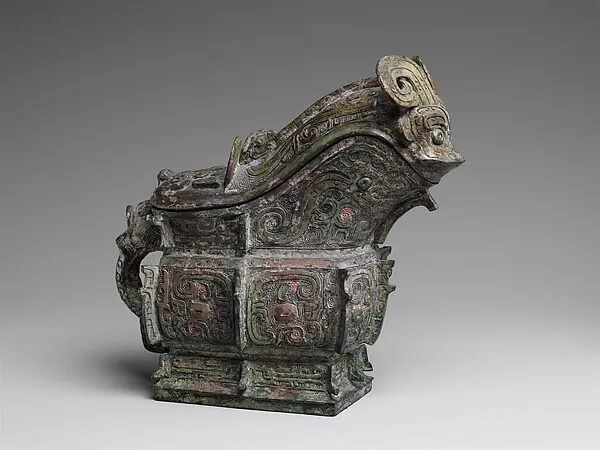
This Western Zhou wine vessel bears a name and a rank designation. It illustrates evidence of elite status in an earlier period; it is not a record of Qin's court debate. The Metropolitan Museum of Art, public domain.
An adapted translation of the debate gives both Wang Wan's proposal and Li Si's response. Qin's earlier use of local administrative districts is part of a longer development before the empire; the decision in 221 BCE should be understood against that background.
Did Hereditary Kingdoms Disappear Permanently?
No. Qin's dynasty fell soon after the First Emperor's death. During the struggle that followed, Xiang Yu distributed territories to kings. The Han dynasty later combined centrally administered commanderies with kingdoms, before the court progressively restricted the power of those kings. Read what came after the Qin dynasty for the transition.
Qin's importance lies in its imperial choice to govern through commanderies and counties across the realm, not in a permanent disappearance of every form of hereditary rule. Later governments adapted the framework while repeatedly reconsidering the place of regional kings.
Frequently Asked Questions
Did Qin Shi Huang invent the commandery-county system?
No. Qin had used such administrative districts before 221 BCE; the empire extended them across conquered lands.
Who advised Qin Shi Huang against appointing regional kings?
According to the Shiji, Li Si argued against the proposal, warning that hereditary regional rulers could become rivals.
Was Zhou enfeoffment identical to European feudalism?
No. Feudalism is sometimes used as a comparison, but the institutions and historical contexts differed.
Did Qin's system end all hereditary kingdoms in Chinese history?
No. After Qin fell, kingdoms returned, and early Han combined them with centrally administered commanderies.